How pass-through PBM models eliminate hidden fees.


Premiums are rising, drug costs are climbing higher each year and the PBM contract that was supposed to control spending often obscures more than it reveals. For most employers, the real issue is understanding the complex mix of factors driving those costs. When PBMs rely on spread pricing, retained rebates and other hidden revenue streams, it becomes difficult to pinpoint what’s actually increasing spend. A pass-through PBM model addresses this directly by removing those mechanisms, creating a structure designed to control costs rather than add to them.
In this article, we’ll break down how pass-through PBM models work, where traditional models introduce hidden costs, and what employers should look for when evaluating their options.
Key highlights:
- A pass-through PBM model is a pharmacy benefit management structure where the PBM charges a fixed administrative fee and passes drug costs, discounts and rebates back to the plan.
- Traditional PBM models generate revenue through spread pricing, rebate retention and other mechanisms embedded in the contract that increase plan costs without appearing as explicit fees.
- Pass-through pricing better aligns the PBM's financial incentives with the plan's interest in reducing drug spend.
- Rightway PBM operates as a 100% pass-through model, meaning every rebate dollar and every discount goes back to the plan—not to Rightway.
What are pass-through PBM models?
Pass-through PBM models are pharmacy benefit management structures where the PBM charges a fixed administrative fee and passes back drug costs, rebates and discounts directly to the plan. They’re gaining attention as employers face accelerating pharmacy cost pressure. Employer pharmacy costs are expected to rise by up to 12% in 2026, according to Business Group on Health, making it more critical to understand where every dollar is going and whether savings are actually being delivered.
But not all “pass-through” models operate the same way. Some still retain a portion of rebates or apply spread pricing in certain areas, limiting how much savings actually reach the plan. A 100% pass-through structure takes this further. There are no partial rebate pass-throughs, no spread on any drug category and no carve-outs for specialty medications. Every dollar of savings the pharmacy benefits manager negotiates flows back to the plan.
How pass-through pricing for PBMs eliminates hidden fees.
Traditional PBM models introduce costs that don't appear as line items in any invoice. The PBM lies that employers are most often told involve spread pricing, rebate retention and contractually obscured revenue structures. Pass-through pricing removes these mechanisms by design.
Pass-through PBMs eliminate hidden fees by:
Reducing spread pricing.
Spread pricing is the difference between what the PBM pays the pharmacy and what it charges the benefits plan. If a pharmacy is reimbursed $80 for a drug and the PBM bills the plan $95, the PBM keeps $15—on every claim, across every drug.
In a pass-through model, the PBM makes no spread on prescription claims. What the pharmacy is paid equals what gets billed to the plan. The plan pays what the drug actually costs, not a marked-up version.
- Spread pricing is the margin a PBM captures between what it pays the pharmacy and what it charges the plan for the same drug.
- Because it is applied per claim across every drug, small markups accumulate into significant overspend.
- In a pass-through contract, the PBM bills the plan exactly what the pharmacy was paid, eliminating any margin.
Passing through all rebates.
Drug manufacturers pay PBMs rebates to secure favorable formulary placement for their brand and specialty drugs. In a traditional model, the PBM negotiates rebates on the plan's behalf but passes through only a portion of them.
In a pass-through model, 100% of PBM rebates go to the plan. Because the PBM retains nothing, it also has no financial incentive to favor higher-rebate drugs over lower-cost alternatives on the formulary.
- PBM rebates are payments made by drug manufacturers to PBMs in exchange for preferred placement on the formulary.
- In a traditional model, the PBM retains a significant portion of those rebates—meaning the plan never sees the full value of the discounts negotiated on its behalf.
- Every rebate dollar is returned to the plan in a pass-through model.
Improving cost predictability.
When a plan's costs are tied directly to actual drug prices—not to a PBM's internal pricing arrangements—forecasting becomes more reliable. This is especially significant for specialty drugs, which often represent the largest share of pharmacy spend and are frequently subject to the most complex pricing arrangements in traditional contracts.
Pass-through pricing means the plan pays the actual negotiated rate for every drug. That predictability has real planning value. Employers can model future spend based on actual drug pricing data, evaluate formulary changes with accurate cost assumptions and budget with greater confidence.
- Specialty drug costs are often the least predictable under traditional PBM pricing structures
- Pass-through pricing ties plan costs directly to actual drug prices, not internal PBM arrangements
- Predictable costs support better benefits design and more accurate financial planning
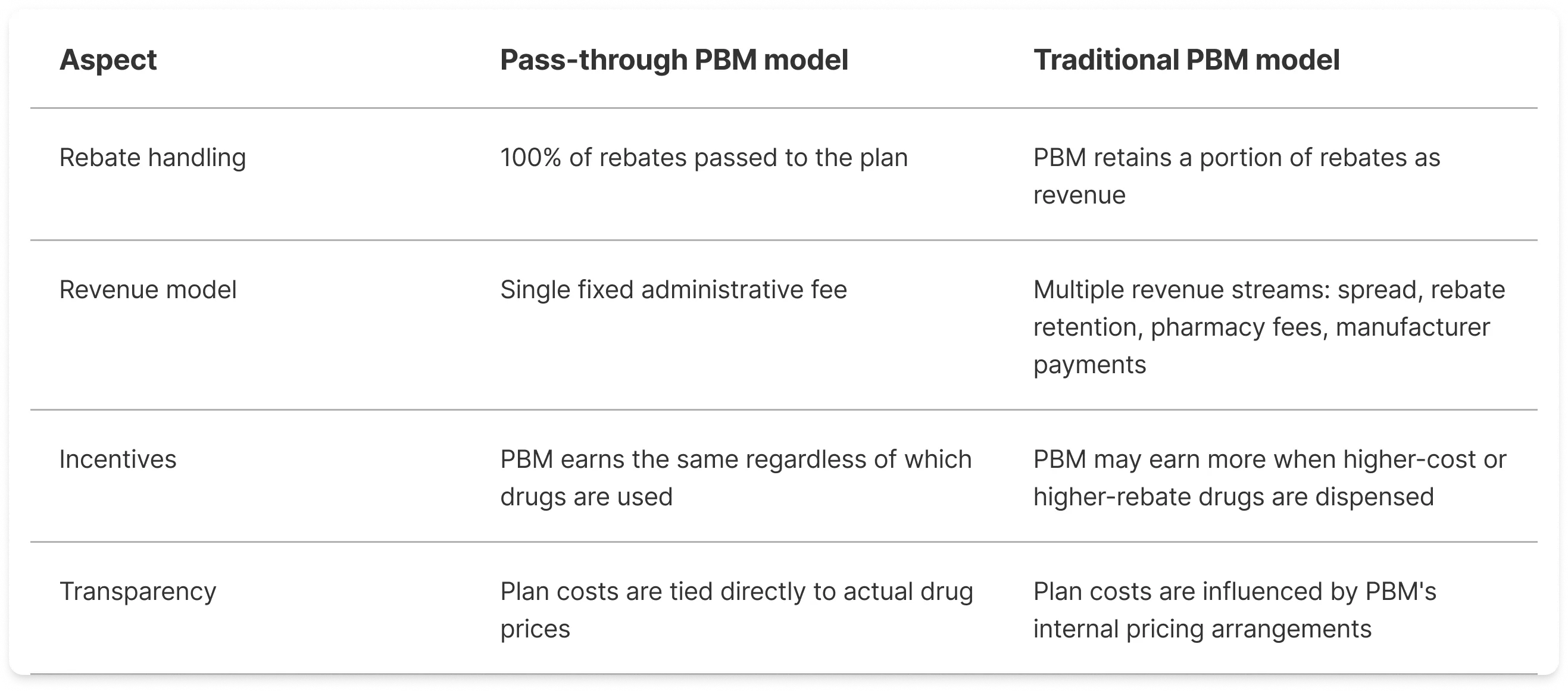
100% pass-through vs traditional PBM models: Key differences.
The differences between pass-through and traditional PBM models go beyond how fees are structured. They reflect different incentive systems—and those incentives shape how the PBM approaches formulary design, network construction and drug utilization management. Understanding the role of PBMs in each model helps plan sponsors evaluate which structure actually serves their interests.
Key features of top transparent PBM providers with pass-through pricing.
Pass-through and transparency are related but different. Pass-through describes how a PBM is compensated—no spread, no retained rebates, fixed admin fee only. Transparency describes how well the PBM reports on costs, utilization and contract terms. The best pass-through PBM companies for transparent pricing deliver both: a clean revenue model and clear reporting that lets plan sponsors act on what they're seeing.
Transparent pricing structure.
A pass-through model eliminates spread pricing—the plan pays actual drug costs, not a marked-up rate. But eliminating spread is only part of the picture. Prescription drug costs should also be reported in a way that lets plan sponsors understand what they're paying and why.
That means claim-level reporting that separates ingredient cost, dispensing fee and applicable discounts—not bundled figures that make it difficult to verify what the plan actually paid. A pass-through structure removes the financial incentive to obscure costs; good reporting makes the actual costs visible and actionable.
Key features to look for:
- Claim-level cost reporting with ingredient cost and dispensing fee itemized separately
- Pricing tied to actual pharmacy reimbursement rates, not internal PBM schedules
- No bundled or netted pricing that obscures individual cost components
Full rebate pass-through.
In a 100% pass-through model, all manufacturer rebates are passed through to the plan. This includes rebates on brand drugs, specialty medications and any other manufacturer payments that function economically like rebates, regardless of how they're classified in the contract.
Full rebate pass-through also changes the PBM's incentives around formulary design. When the PBM doesn't retain any portion of rebates, it has no financial reason to favor higher-rebate drugs over lower-cost alternatives. The formulary can be built around clinical value and net cost to the plan, rather than on what generates the most rebate revenue for the PBM.
Key features to look for:
- 100% rebate pass-through contractually guaranteed with no carve-outs
- Rebate reporting at the drug and claim level, not just as a lump sum
- Disclosure of all manufacturer payments, including those not classified as traditional rebates
Administrative fee model.
In a top pass-through model, the administrative fee should be the PBM's only source of revenue. That fee should be fixed, clearly defined in the contract and not variable based on drug mix, utilization or rebate volume.
This structure matters because it removes the conflicts of interest that arise when a PBM earns more by steering utilization toward certain drugs or dispensing channels.
Key features to look for:
- Fixed per-member-per-month or per-claim administrative fee
- No variable fees tied to drug mix, rebate volume or utilization patterns
- Full disclosure of what the admin fee covers, so plan sponsors know exactly what services they are paying for.
Aligned incentives.
In a traditional model, the PBM's revenue is tied to drug spend in ways that can create conflicts with the plan's interest in reducing costs. When leveraging a pass-through model, many of these conflicts are structurally removed.
The best pass-through PBMs are also structured to actively support cost reduction: through clinical programs that steer members toward lower-cost alternatives, formulary design that prioritizes net cost over rebate generation and analytics that help plan sponsors identify and act on savings opportunities.
Key features to look for:
- Clinical programs designed to reduce plan cost, not increase utilization of high-rebate drugs
- Formulary design based on net cost and clinical value
- Plan analytics that surface actionable cost reduction opportunities
Control pharmacy spend with Rightway’s 100% pass-through model.
Rightway is built as a 100% pass-through PBM for employers who want predictable pharmacy spend, full financial alignment and confidence that every dollar is accounted for. Unlike traditional models that obscure the true cost of medications through complex pricing and hidden fees, Rightway provides full visibility into those costs.
With built-in protections like SureSpend™, employers can move from reacting to cost fluctuations to proactively managing their plans and consistently driving cost savings.
Rightway 100% pass-through model includes:
- Full rebate pass-through with every manufacturer rebate returned to the plan and reported at the claim level
- No spread pricing on any claim, with pharmacy reimbursement and plan billing matching exactly
- A fixed administrative fee as the only revenue Rightway earns, clearly defined in the contract
- Formulary design based on net cost and clinical value, with no rebate retention influencing drug placement
Book a demo today and explore how Rightway’s 100% pass-through model can enhance healthcare benefits for your employees.
Frequently asked questions.
PBM pass-through pricing is a model where the pharmacy benefit manager charges the employer exactly what it pays for medications—without adding hidden margins or retaining rebates. Instead of profiting from the cost of drugs, the PBM earns revenue through a clearly defined administrative fee. This removes the financial incentive to steer toward higher-cost medications and creates a more transparent, aligned structure.