Leading pharmacy benefit manager companies in 2026.

Pharmacy benefit manager companies

Employers are facing growing pressure from rising health plan costs. Spending continues to climb, and employers are expected to see costs increase by roughly 9% in 2026, according to the Segal Group, with most of that growth tied to prescription drug spending. As a result, many organizations are taking a closer look at the pharmacy benefit managers (PBMs) they rely on to manage prescription drug benefits.

This article provides an overview of leading pharmacy benefit manager companies in 2026 and highlights how different PBM models approach cost management, clinical oversight and pharmacy benefit administration.

What is a pharmacy benefit management company?

A pharmacy benefit management company is an organization that administers prescription drug benefits for employers, insurers and other healthcare organizations. Pharmacy benefit managers act as intermediaries between health plans, pharmacies and pharmaceutical manufacturers, helping to:

  • Determine which medications are covered
  • Negotiate drug pricing
  • Process prescription drug claims

PBMs help employers manage the drug formulary (including coverage and tiers), negotiate rebates, and oversee specialty medications that can drive a large share of pharmacy spend. They also apply cost-containment strategies, such as prior authorization, step therapy, network design, and channel management, to influence how prescriptions are filled and what the plan and the member pay.

9 top pharmacy benefit management companies in 2026.

The PBM market includes a mix of long-established incumbents and newer companies offering alternative models. The three largest pharmacy benefit management companies—CVS Caremark, Express Scripts and OptumRx— dominate the industry, controlling roughly 80% of the market according to the Federal Trade Commission.

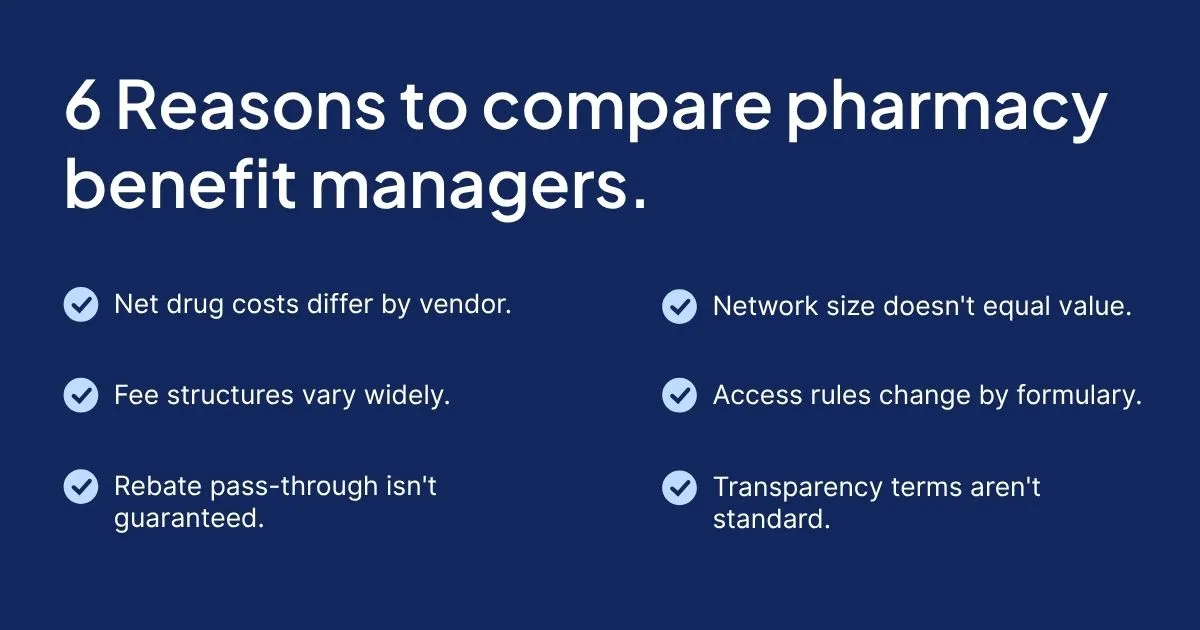
For plan sponsors comparing PBMs, the biggest differences often come down to pricing models and incentives. These factors influence how drug benefits are managed, how rebates and other tactics are used, and how the pharmacy network is structured.

Here are the top PBMs in 2026 and the different models shaping the market today.

1. Rightway

Rightway is a pharmacy benefit manager designed around a fully aligned, fiduciary model. Unlike many PBMs that are vertically integrated with insurers or pharmacies, it owns 0% of the pharmacy supply chain, eliminating incentives tied to dispensing volume or pharmacy steerage. The platform leverages a transparent structure with a single administrative fee, no spread pricing, and a 100% pass-through of rebates, helping employers see the true cost of their pharmacy benefits.

As well, Rightway centers its model on pharmacy navigation, a high-touch service delivered by licensed pharmacists and certified pharmacy technicians. This team helps members identify lower-cost medication options, manage specialty prescriptions, enroll in savings programs, and coordinate directly with providers and pharmacies.

Rightway pros

  • Neutral PBM model with no ownership in the pharmacy supply chain
  • 100% rebate and discount pass-through
  • Transparent and aligned model with no spread pricing or hidden revenue streams
  • Pharmacist-led pharmacy navigation to guide members to high-value medication
  • Modern technology platform with real-time reporting and member support tools

2. CVS Caremark

CVS Caremark is one of the largest pharmacy benefit managers in the U.S. and part of CVS Health, which also owns retail and specialty pharmacies as well as the insurer Aetna. As one of the PBM industry’s “Big 3,” the company manages prescription drug benefits on a large scale and operates an extensive pharmacy network supported by CVS’s retail and specialty infrastructure.

CVS Caremark pros:

  • Large scale and brand recognition
  • Extensive retail and specialty pharmacy footprint
  • Established national infrastructure

Cons of CVS Caremark:

  • Vertically integrated model creates conflicts of interest
  • Revenue tied to rebates, spread pricing and in-house pharmacy dispensing
  • Formularies may prioritize high-rebate drugs, not the lowest-net-cost
  • PBM model is subject to regulatory scrutiny around PBM practices

3. Express Scripts

Express Scripts is one of the largest pharmacy benefit managers in the United States and operates within Evernorth, the health services division of Cigna. The company provides pharmacy benefit management services including formulary design, pharmacy network management and clinical programs for employers, health plans and government programs.

Express Scripts pros:

  • Large national scale and established PBM infrastructure
  • Extensive specialty pharmacy capabilities
  • Integration with Cigna’s broader healthcare services

Cons of Express Scripts:

  • Vertical integration creates incentive misalignment
  • Limited transparency in pricing and rebate structures
  • Specialty pharmacy profits influence formulary and utilization decisions
  • Increasing scrutiny from lawmakers and employers over PBM practices

4. Optum Rx

Optum Rx is a pharmacy benefit manager within Optum, the health services arm of UnitedHealth Group. The company manages prescription drug benefits for employers, health plans and government programs while operating alongside UnitedHealthcare and other Optum healthcare services.

Optum Rx pros:

  • Large national scale and established PBM infrastructure
  • Access to extensive healthcare data through the Optum and UnitedHealth ecosystem
  • Broad specialty pharmacy and clinical program capabilities

Cons of Optum Rx:

  • Vertical integration across UnitedHealthcare, Optum and owned pharmacies can create conflicts of interest
  • Revenue tied to rebates and internal pharmacy dispensing
  • Limited transparency into pricing and rebate structures
  • Increasing scrutiny from regulators and large employers over PBM practices

5. Navitus

Navitus Health Solutions is an independent pharmacy benefit manager that focuses on pass-through pricing and transparency. The company provides pharmacy benefit administration, formulary management and pharmacy network services while partnering with external pharmacies rather than owning dispensing assets.

Navitus pros:

  • Independent PBM structure without owned retail pharmacies
  • Pass-through approach to rebates and discounts
  • Emphasis on affordability and reducing low-value drug utilization
  • Real-time reporting dashboards for plan oversight

Cons of Navitus:

  • Pharmacist support is typically outsourced rather than embedded
  • Member engagement tends to be transactional rather than personalized
  • Reliance on a single pricing benchmark (NADAC) can limit flexibility
  • Technology platform offers limited customization for individual member experience

6. Judi Health (Capital Rx)

Judi Health is a pharmacy benefit manager that recently rebranded from Capital Rx as it expands into a broader benefits administration platform covering pharmacy, medical, vision and dental. The company operates through its Judi technology platform, which centralizes claims processing and plan management with a focus on automation and operational efficiency.

Judi Health (Capital Rx) pros:

  • Strong technology platform (Judi®) for real-time claims management and administration
  • Transparent pricing model with flat administrative fees and rebate pass-through
  • Customizable formulary design with client visibility into drug costs
  • Integrated platform designed to manage multiple benefits beyond pharmacy

Cons of Judi Health (Capital Rx):

  • Member engagement is primarily technology-driven rather than pharmacist-led
  • Clinical support may be less personalized than models with embedded pharmacists
  • Reliance on the NADAC benchmark can limit pricing flexibility
  • Expansion into broader benefit administration may shift focus from PBM-specific services

7. SmithRx

SmithRx is a newer pharmacy benefit manager that focuses on a pass-through pricing model and simplified administrative fees. The company provides pharmacy benefit management services through a technology platform designed to help employers identify lower-cost medication options and manage pharmacy claims.

SmithRx pros:

  • Pass-through PBM model with flat administrative fees
  • Customizable formulary design focused on lower-cost drugs
  • Technology tools to help identify lower-priced medication options
  • Partner portal with access to claims data and reporting

Cons of SmithRx:

  • No clinical pharmacists are directly supporting members
  • Member support is primarily handled through general service teams
  • Limited proactive outreach and engagement with members
  • Technology platform includes a web portal but no dedicated mobile app

8. AffirmedRx

AffirmedRx is a pharmacy benefit manager that focuses on transparent pricing and fiduciary-aligned pharmacy benefit management. The company offers a flat-fee model with rebate pass-through and positions its services around improving affordability and reducing low-value drug utilization.

AffirmedRx pros:

  • Transparent flat-fee pricing model with rebate pass-through
  • Emphasis on fiduciary alignment and affordability
  • Clinically informed formulary design focused on reducing low-value drug use
  • Technology platform provides real-time reporting for plan oversight

Cons of Prime AffirmedRx:

  • Pharmacist-led navigation is not consistently embedded in the model
  • Member engagement relies more on digital tools and service teams
  • Clinical support may be less personalized than pharmacist-led models
  • Reliance on a single index can limit pricing flexibility

9. LucyRx

LucyRx is a pharmacy benefit manager focused on transparent pricing and simplified pharmacy benefit administration. The company provides pharmacy benefit services for employers and health plans and recently expanded its scale through the acquisition of CerpassRx.

LucyRx pros:

  • Transparent flat-fee pricing model with rebate pass-through
  • Centralized clinical team supporting utilization management and formulary oversight
  • Data analytics platform (LucyIQ) for pharmacy spend insights and reporting
  • Expanded scale and specialty pharmacy partnerships following the CerpassRx acquisition

Cons of LucyRx:

  • No embedded pharmacist support for direct member engagement
  • Member experience relies primarily on general support teams and a self-service tool
  • Pricing tied to a single benchmark, limiting flexibility as drug markets shift
  • Formularies may offer less customization and fewer cost-control mechanisms than more clinically driven models

Why choosing the right pharmacy benefit management company matters.

Selecting the right pharmacy benefit manager can have a significant impact on both pharmacy costs and the member experience. PBMs influence everything from which medications are covered to how drugs are priced, dispensed and managed across the pharmacy network. Because of this, differences in models, incentives and clinical support can lead to very different outcomes for employers and their members.

Here are the main benefits of partnering with the right PBM company:

Controlling long-term healthcare costs.

Prescription drugs continue to represent a large share of overall healthcare spending for employers. According to the Business Group on Health, 27% of employer healthcare spending now goes to prescription drugs. Pharmacy benefit manager companies influence how medications are priced, how utilization is managed and how prescription drug claims are processed across the pharmacy network. These decisions can significantly affect both short-term pharmacy costs and long-term spending trends.

One of the most effective ways to control pharmacy spend is by focusing on clinically appropriate, lower-cost medication options. For many conditions, generics and biosimilars provide the same clinical value. Understanding how PBMs manage generic drug pricing can help employers evaluate whether their plan design is inadvertently guiding members toward higher-value medications.

Key cost-control considerations include:

  • How the PBM manages prescription drug claims and pharmacy network pricing
  • Whether formularies prioritize clinically appropriate generic and biosimilar drugs
  • How utilization management programs prevent unnecessary or duplicative prescriptions
  • Whether specialty drug programs help manage high-cost therapies

Ensuring pricing transparency and financial alignment.

PBM pricing models vary widely, and not all models are designed to align incentives with employers. Some PBMs generate revenue through rebate retention, spread pricing or pharmacy ownership, which can make it difficult for plan sponsors to understand the true cost of medications.

A model that is fiduciary aligned focuses on transparency and clear financial incentives. In these arrangements, the PBM does not benefit from higher drug prices or increased prescription volume. Instead, structures are designed so employers have clear visibility into drug costs, rebates and administrative fees.

Employers evaluating PBM transparency should consider:

  • Whether rebates and discounts are passed through to the plan sponsor
  • If cost structures eliminate spread pricing and hidden markups
  • How clearly administrative fees and service costs are disclosed
  • Whether the PBM’s incentives align with reducing pharmacy spend

Improving the member pharmacy experience.

The quality of the prescription drug benefit experience can significantly influence medication adherence, overall health outcomes and employee benefits satisfaction. Members often need help understanding their medication options, navigating prior authorizations or finding lower-cost alternatives.

When members receive clear guidance and support, they are more likely to take medications correctly and avoid unnecessary delays in care. PBMs that provide proactive engagement and pharmacy support can help members better understand their pharmacy benefits and access the medications they need.

Employers may want to evaluate:

  • Whether members can easily access support for prescription questions
  • How members receive guidance on lower-cost or clinically appropriate medications
  • If digital tools help members understand pricing and pharmacy options
  • Whether the PBM offers proactive outreach to support medication adherence

Strengthening clinical oversight and medication safety.

Pharmacy benefits involve complex clinical decisions that affect both patient outcomes and plan costs. PBMs play an important role in reviewing medications, managing prior authorizations and ensuring prescriptions follow evidence-based guidelines.

Stronger clinical oversight can help identify inappropriate therapies, reduce medication risks and ensure members receive the most effective treatments. Programs such as medication reviews, specialty pharmacy management and step therapy policies are often used to improve member outcomes while controlling costs.

Important clinical considerations include:

  • Whether licensed pharmacists are involved in reviewing medication therapy
  • How the PBM evaluates drug safety and clinical effectiveness
  • The role of utilization management programs such as prior authorization
  • How specialty drugs and complex therapies are monitored

Reducing administrative complexity and compliance exposure.

Managing pharmacy benefits involves significant administrative responsibilities for employers and benefits teams. PBM contracts, reporting requirements and compliance obligations can put an organization at risk without the right systems and support in place.

A well-structured PBM partnership can simplify operations by providing clear reporting, implementation support and tools that help benefits teams manage pharmacy programs more efficiently. This can reduce administrative burden while helping organizations maintain compliance with changing healthcare regulations.

Employers should evaluate:

  • The level of reporting and analytics provided by the PBM
  • Whether the PBM offers implementation and ongoing support for benefits teams
  • How easily employers can access claims data and utilization insights
  • Whether the PBM helps organizations maintain compliance with healthcare regulations

How to evaluate pharmacy benefit management companies.

Choosing a PBM isn’t just about comparing prices. The PBM you select will influence how drugs are covered, how medications are priced and how members navigate the pharmacy system every day. Employers should take time to understand the role of PBMs and how different models operate before making a decision.

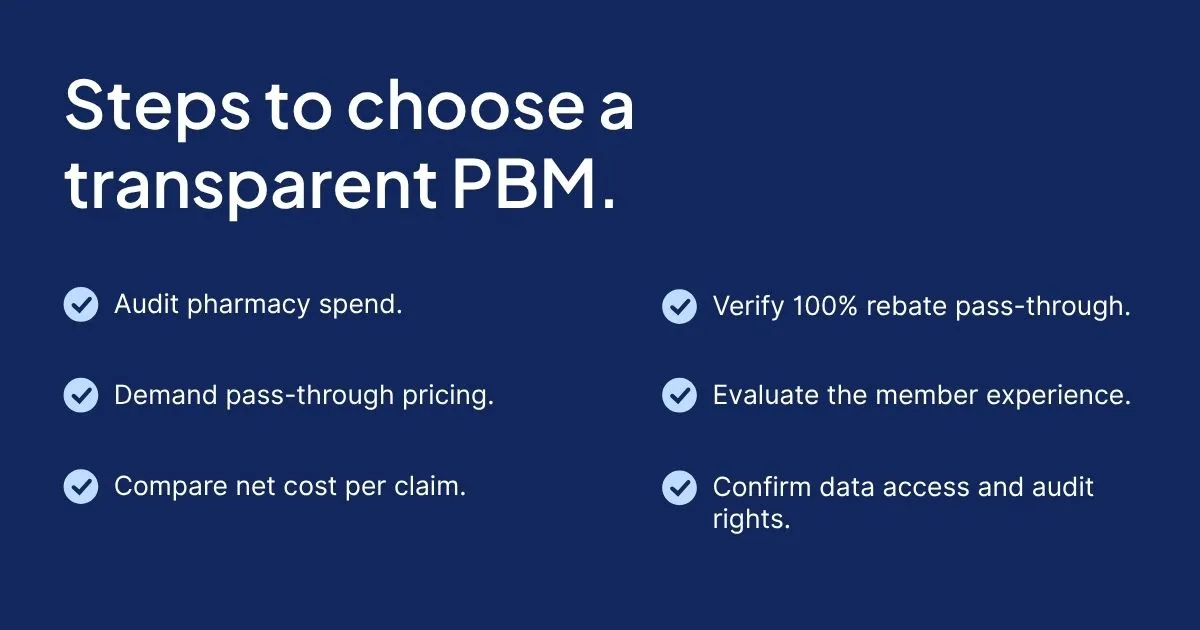
Looking beyond marketing claims and focusing on how the model actually works can help organizations choose a PBM that supports both cost control and a better member experience. Here are six practical factors employers should look at when evaluating pharmacy benefit management companies:

1. Review pricing structure and transparency.

A PBM’s model determines how prescription drugs are priced, reimbursed and ultimately paid for by employers and members. Some solutions rely on complex financial arrangements that include retained rebates, pharmacy ownership or spread pricing, where the benefits manager charges the plan more for a drug than it reimburses the pharmacy. These practices can make it difficult for employers to fully understand the true cost of their coverage.

Employers evaluating multiple vendors should look for clear explanations of how costs work and whether incentives align with lowering drug costs. Greater PBM model transparency helps plan sponsors understand where pharmacy dollars are going and how savings are generated.

Things to review include:

  • Whether the PBM uses spread pricing or other hidden revenue streams
  • How drug prices are calculated across the pharmacy network
  • Whether cost models provide clear visibility into pharmacy costs
  • If administrative fees and pharmacy reimbursements are fully transparent

2. Assess rebate and discount handling.

Rebates and discounts negotiated with drug manufacturers can represent a significant portion of pharmacy benefit economics. PBMs often negotiate these rebates on behalf of health plans, but how those savings are handled can vary widely across PBM models.

Some benefit managers retain a portion of the negotiated rebates, while others pass them through to employers. Understanding how rebates are managed is a key part of effectively managing pharmacy benefits and ensuring savings flow back to the plan.

Employers should consider:

  • Whether negotiated rebates are fully passed through to the employer
  • How rebate guarantees and projections are structured
  • Whether rebates influence formulary decisions

3. Evaluate clinical management capabilities.

PBMs play an important role in guiding how medications are prescribed and used. Clinical programs influence which drugs are covered, when prior authorization is required and how specialty medications are managed.

Strong clinical management helps ensure members receive appropriate therapies while avoiding unnecessary drug spending. Employers should understand how clinical programs operate and how actively the PBM supports safe and effective medication use.

Important clinical considerations include:

  • The role pharmacists play in the member experience
  • How formularies are designed and updated
  • Whether utilization management programs follow evidence-based guidelines
  • How specialty medications and complex therapies are monitored

4. Examine performance guarantees and accountability.

Many PBMs offer guarantees related to pricing, rebates or overall pharmacy performance. These guarantees can provide a baseline level of accountability, but the details behind them matter.

Employers should carefully review what guarantees actually cover and how they are measured, as some guarantees focus only on specific drug categories or exclude high-cost medications, limiting their real impact.

Key evaluation points include:

  • What pharmacy cost guarantees are included in the contract
  • Whether guarantees apply to total pharmacy spend or select categories
  • How financial penalties or refunds are structured if guarantees are missed

5. Verify reporting, data access and audit rights.

Clear reporting is essential for understanding how pharmacy benefits are performing. Without access to detailed data, employers may struggle to identify cost drivers or evaluate whether their PBM is meeting expectations.

PBMs should provide reporting that gives employers visibility into prescription utilization, drug spending and rebate activity. Access to transparent data also supports contract oversight and ongoing performance evaluation.

Employers may want to verify:

  • Access to detailed prescription and claims reporting
  • Transparency into rebate and pricing data
  • Whether plan sponsors have audit rights within the PBM contract
  • Availability of dashboards or analytics tools for reviewing pharmacy trends

6. Consider the implementation and client service model.

Transitioning to a new PBM can be operationally complex. Eligibility files, claims systems, pharmacy networks and member communications all need to be coordinated carefully to avoid disruption. Employers should evaluate how the PBM manages implementation and whether the process is structured to minimize administrative burden for benefits teams.

The level of ongoing support a PBM provides is just as important. Some PBMs rely heavily on standard service models, while others provide more hands-on guidance to help employers manage their drug formulary, analyze pharmacy spend and respond to member issues as they arise.

Key areas to evaluate include:

  • The PBM’s implementation process and transition support for new clients
  • Whether dedicated account teams or clinical experts are assigned to the plan
  • The level of strategic guidance provided throughout the contract
  • Support for formulary management, reporting and benefit design changes

Enhance the management of your pharmacy benefits with Rightway.

Many pharmacy benefit manager companies promise transparency and cost savings, but their financial models often rely on retained rebates, pharmacy ownership or other incentives tied to higher drug spending. These models can make it difficult for employers to fully understand pharmacy costs or ensure the PBM is acting in the plan’s best interest.

Rightway PBM was built to solve these challenges with a fully aligned model that prioritizes transparency, clinical guidance and measurable cost control. Through pharmacist-led navigation and a transparent pricing structure, our model helps employers simplify pharmacy benefit management, lower pharmacy costs, and improve outcomes for members.

Rightway’s key differentiators include:

  • 100% pass-through cost model with no spread pricing, retained rebates or hidden fees
  • Pharmacist-led pharmacy navigation that proactively guides members to lower-cost, clinically appropriate medications
  • Precision Pricing Guarantee that caps total pharmacy spend and refunds employers if costs exceed projections
  • Zero-Markup Wrap protection for high-cost drugs like GLP-1s and rare therapies
  • No pharmacy ownership, eliminating conflicts of interest in dispensing decisions
  • Full transparency and auditable reporting that gives employers clear visibility into pharmacy costs

Book a demo today to see how Rightway can enhance the management of your pharmacy benefits.


SHARE


Related content.
orange bills on money
Pharmacy benefits

PBM reform update: What employers must know about CAA 2026 and DOL PBM disclosure rule.

Read more PBM reform update: What employers must know about CAA 2026 and DOL PBM disclosure rule.
Benefits leader on laptop
Pharmacy benefits

Healthcare benefits & PBM glossary for employers.

Read more Healthcare benefits & PBM glossary for employers.
Hand holding an assortment of prescription pills
Pharmacy benefits

What is a pharmacy benefit manager (PBM)?

Read more What is a pharmacy benefit manager (PBM)?
female pharmacist at pharmacy counter
Pharmacy benefits

5 eye-opening takeaways from Rightway’s 2024 PBM Annual Report.

Read more 5 eye-opening takeaways from Rightway’s 2024 PBM Annual Report.
hands holding phone with podcast on screen
Pharmacy benefits

5 key takeaways for benefits leaders from Bloomberg's Vanguards of Health Care Podcast.

Read more 5 key takeaways for benefits leaders from Bloomberg's Vanguards of Health Care Podcast.
Rightway | Clinical Care Navigation | Effective Transparent PBM.
Pharmacy benefits

What is a drug formulary? Tiers, costs, and how it works.

Read more What is a drug formulary? Tiers, costs, and how it works.
Tyson Foods headquarters sign
Pharmacy benefits

5 lessons from Tyson Foods’ PBM transformation.

Read more 5 lessons from Tyson Foods’ PBM transformation.
Man smiling at smartphone
Pharmacy benefits

4 proven ways to keep members happy during a PBM transition.

Read more 4 proven ways to keep members happy during a PBM transition.