6 key metrics to optimize healthcare benefits.


When employee healthcare benefits are working properly, workforce health improves, and bottom-line spending stays predictable. However, rising specialty drug trends and fragmented point solutions make plan benefits package optimization an ongoing trial for leaders. To take control of total cost, HR directors and CFOs need transparent, data-driven performance indicators.
Using the right metrics to track the success of benefits program offerings helps organizations uncover hidden waste, evaluate vendor performance, and benchmark clinical engagement.
Key highlights:
- Healthcare benefits optimization is the ongoing work of tuning plan cost, usage, and value against clear metrics so the plan serves both your people and your budget.
- Six metrics give you a full read on plan health: total healthcare spend, employee engagement, employee satisfaction, benefits ROI, preventive care compliance, and point solution utilization.
- Data silos, weak communication, and low engagement are the reasons most plans underperform, and each one is fixable.
- Rightway’s care navigation solution connects members to high-value care and lifts the metrics you already track.
What is healthcare benefits optimization?
Healthcare benefits optimization is the ongoing process of managing a health plan's cost, utilization, and outcomes so it delivers real value for both employees and the business. It means tracking metrics, such as total healthcare spend, employee engagement, and benefits ROI alongside preventive care compliance and point solution utilization, then acting on what those numbers show.
Employers that optimize their healthcare benefits fix the underlying obstacles, such as data silos and weak communication. Many also pair their plan with a care navigation solution, which steers employees toward high-value care and directly moves the metrics that define a well-optimized benefits program.
6 key healthcare benefits metrics.
To build a successful, cost-effective healthcare strategy, you need to track the key metrics to measure the success of a benefits program across both financial performance and employee well-being.
| Healthcare benefits metric | What it measures | Why it matters | Where to measure it |
|---|---|---|---|
| Total healthcare spend | Overall cost of providing health benefits | Direct link to budget risk and cost control | Claims data and PMPM calculations |
| Employee engagement | Participation in health programs | A driver of better outcomes and lower costs | Program enrollment and usage data |
| Employee satisfaction | Sentiment toward benefits | A factor in retention, productivity, and recruitment | Benefits surveys and NPS |
| Benefits ROI | Financial return on healthcare investment | Proof that benefits deliver value for the spend | Cost versus outcome comparison |
| Preventive care compliance | Adherence to recommended screenings | Key to early detection and lower long-term costs | Claims and screening completion rates |
| Point solution utilization | Usage of point solutions like telehealth | Signal of whether vendor investment is paying off | Vendor usage reports |
Together, these metrics measure what's working, what needs improvement, and how to align your benefits with organizational goals and employee needs.
1. Total healthcare spend.
Healthcare spend tracking is crucial for budgeting and financial planning, as it reflects the direct cost burden of providing health benefits. Budgeting should account for your organization's growth and rising cost trends.
Analyzing healthcare spending can help organizations identify cost drivers, such as high rates of emergency room visits or expensive prescription medications, and develop strategies to manage these expenses more effectively.
Learn how to lower your healthcare spend.
2. Employee engagement.
Employee engagement measures the level of employee participation in the organization's health programs. Higher engagement with benefits levels often leads to better health outcomes and lower overall costs. When employees actively participate in wellness initiatives like fitness challenges or smoking cessation programs, they are more likely to adopt healthier behaviors, which can reduce the prevalence of chronic diseases and decrease healthcare costs.
Engaged employees are also more likely to utilize preventive services, avoiding more severe health issues down the line.
3. Employee satisfaction.
Satisfaction with health benefits is a critical metric that influences overall health and productivity. Happy employees are more likely to utilize their health benefits effectively, contributing to overall health and productivity and supporting related employee engagement metrics.
For instance, if employees are happy with their mental health support options, they are more likely to seek help early, leading to better mental health outcomes and reduced absenteeism. High satisfaction levels can also enhance employee retention and attract top talent, making it a vital metric for competitive advantage.
4. Benefits return on investment (ROI).
ROI measures the financial return on healthcare investments. Ensuring that the organization’s healthcare benefits deliver value for the money spent is crucial. Investing in a robust care navigation platform that helps employees find cost-effective healthcare solutions and avoid unnecessary procedures can significantly boost your benefits ROI calculation.
5. Preventive care compliance.
Measuring whether employees follow recommended preventive care guidelines matters for both your team's health and your bottom line. Preventive care compliance tracks whether your workforce completes essential screenings like mammograms and colonoscopies that enable early detection of serious conditions.
Early intervention improves health outcomes and reduces the long-term cost of care. Monitoring this metric uncovers gaps in care and guides strategies to increase consistent use of preventive services across your workforce.
6. Point solution utilization.
Identifying and implementing high-quality point solutions, such as telehealth services and mental health support, takes considerable time and money. High utilization rates show that employees are taking advantage of these specialized resources, which can lower healthcare costs and improve outcomes.
When a point solution goes unused, dig into why and decide whether it still earns its place in your benefits lineup.
Challenges in optimizing healthcare benefits performance.
Most benefits programs hit the same obstacles before they ever get to measurement. Vendor sprawl is a big one: PwC's Employer Benefits Perspective Survey found that 25% of employers work with more than 20 different benefits vendors, and their number-one barrier to adoption is employee engagement.
Four obstacles get in the way of optimizing a benefits program most often:
- Data silos: Fragmented data across different systems can prevent a comprehensive analysis.
- Ineffective benefits communication: Poor communication channels can result in employees being unaware of or not fully understanding their health benefits, leading to underutilization.
- Low employee engagement: Low engagement in health programs can lead to poor health outcomes and higher costs.
- Complexity of care coordination: Care management across multiple providers and services can be challenging and inefficient for your teams.
How to track healthcare benefits metrics effectively.
To effectively track healthcare benefits, HR and leaders should focus on: spend, utilization, and engagement. These areas reveal what’s driving costs, how benefits are being used, and whether they’re delivering value.
- Healthcare spend: Use consolidated analytics platforms to track claims data, pharmacy costs, and vendor reporting. Identify trends like ER overuse or high-cost prescriptions.
- Employee engagement: Monitor participation in wellness programs, surveys, and care navigation tools to assess involvement and impact.
- Benefits ROI: Evaluate the return on specific programs by comparing costs with outcomes—such as improved health, reduced absenteeism, and higher satisfaction.
Set clear benchmarks, monitor preventive care compliance, and review point solution utilization by team or demographic. Regular data reviews help uncover care gaps, improve outcomes, and ensure your benefits strategy stays aligned with employee needs and business goals.
How to optimize your healthcare benefits: 5 steps to control costs without compromising care.
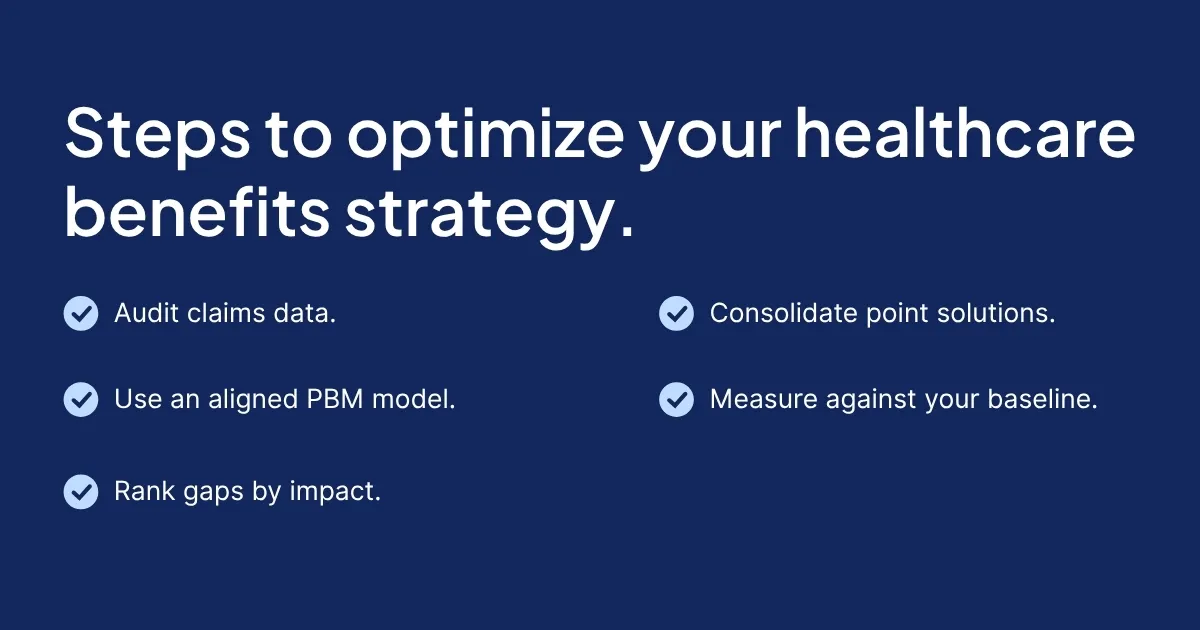
Optimizing healthcare benefits requires a data-driven strategy that eliminates plan waste without compromising care quality. Relying on reactive annual renewals leaves plan sponsors trapped between rising costs and workforce dissatisfaction. A proactive optimization plan directly aligns financial accountability with employee health and satisfaction.
Follow these five steps to control total spend while improving health outcomes across your organization:
1. Audit medical and pharmacy claims data for hidden waste.
In practice, auditing means pulling combined medical and pharmacy claims history to evaluate where spending concentrates. This unified view surfaces three primary sources of waste:
- Spread pricing, where a traditional PBM charges the plan significantly more than it pays the dispensing pharmacy
- Misclassified specialty drugs are billed at inflated tiers when lower-cost generic or biosimilar alternatives exist
- Avoidable emergency room visits that could be redirected to primary or virtual care
Mapping claims against these three areas establishes a clear baseline and tells benefits leaders exactly what to fix first to control total spend and improve specialty drug management.
2. Transition to a neutral, pass-through pharmacy benefit model.
A neutral, pass-through pharmacy benefit manager (PBM) charges a single administrative fee, passes through 100% of manufacturer rebates, and holds zero ownership of the supply chain it prices. Traditional PBM models profit from hidden spread pricing, retained PBM rebates, and steering prescriptions to PBM-owned pharmacies instead.
Specialty drug trend hit 10.8% gross and 12.5% net of rebates in 2025, per the 2026 Artemetrx State of Specialty Spend and Trend Report, which is the growth that pharmacy benefit plan optimization has to catch before it hits the plan. Human-led utilization management, covering prior authorization, specialty drugs, and GLP-1s, is the mechanism that keeps those high-cost categories in check.
3. Rank the remaining gaps by cost and member impact.
Rank engagement, satisfaction, preventive care compliance, and point solution utilization on two axes:
- Cost impact
- Member impact.
A low-cost, low-uptake wellness perk, such as a gym discount app, ranks below a high-cost preventive care gap like incomplete cancer screenings or unmanaged chronic conditions, because the screening gap carries more cost risk and reaches more people. Fix the gaps that score highest on both axes first.
4. Consolidate vendor contracts and point solutions onto one platform.
Telehealth, mental health support, and wellness apps often run on separate contracts, separate administrative overhead, and separate member logins, which is the complexity of the care coordination problem named earlier showing up inside the point solutions themselves. The fix for that fragmentation:
- Review every vendor contract at renewal.
- Cut or renegotiate the ones with low utilization.
- Route what's left through one member-facing entry point.
Routing everything through a single, clinically led care navigation platform removes that administrative friction and gets employees to actually use the high-value support you already pay for.
5. Compare post-change metrics against your baseline.
The medical and pharmacy claims data audit measured total spend by category, spread pricing exposure, specialty drug misclassification, and ER utilization. Measure those same four metrics again and compare them to that baseline. Track them quarterly for a quick operational check, and run a deeper review at annual renewal to decide what to keep, cut, or renegotiate next.
How care navigation improves health benefit plan performance.
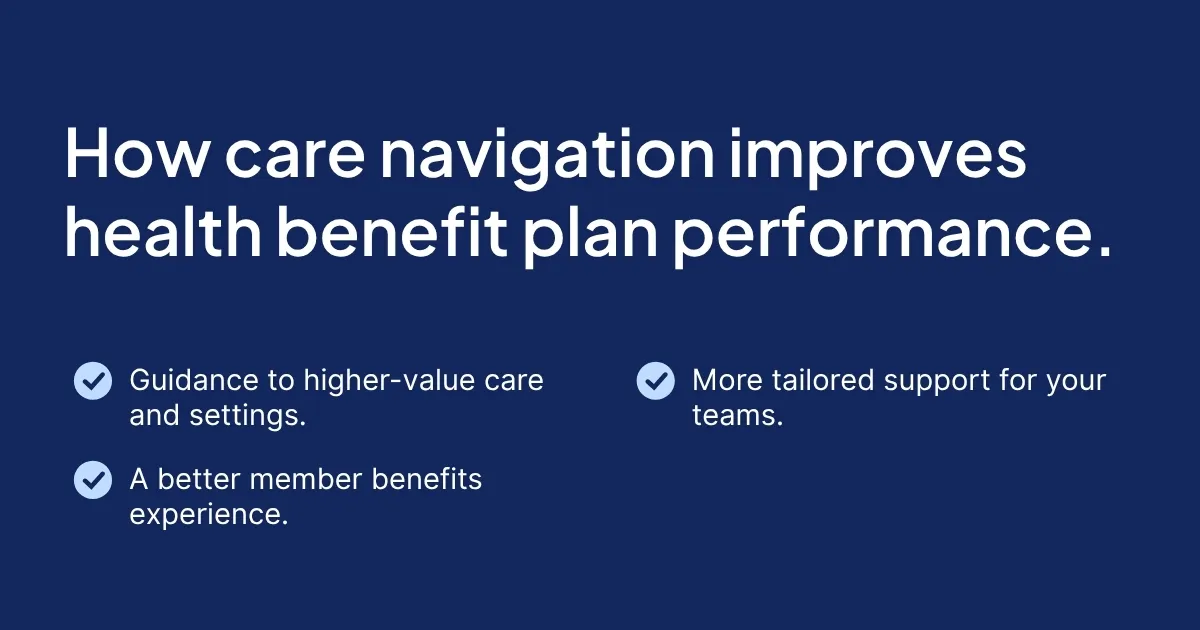
Care navigation is the front door to your entire health ecosystem, turning a complex benefits package into a simple, guided experience for members. Unlike non-clinical call centers or automated AI bots, clinically-led care navigation pairs intuitive mobile technology with multidisciplinary teams of registered nurses, health guides, social workers, and billing specialists.
Here's how care navigation improves plan performance:
Guidance toward high-value care.
Care navigation services help employees find the best care options at the most affordable prices. By offering personalized guidance, Rightway ensures that employees avoid unnecessary and expensive treatments and instead receive high-value care. They also identify high-quality, in-network providers and recognize when members are behind on preventive care or need to visit a primary care provider. This approach lowers costs and improves outcomes.
A better healthcare experience for members.
Healthcare navigation solutions provide a supportive healthcare experience for your teams. When members have health needs, they have access to a health guide who can direct them to high-value care, like preventive care and other wellness programs, or answer their questions. The comprehensive support through a care navigation platform boosts satisfaction by taking the work off each member’s place during their time of need.
Tailored support for your teams.
Health navigation services optimize the use of healthcare resources unique to your organization, such as telehealth, mental health support, and other point solutions. Healthcare navigators guide employees toward these services and follow up to ensure they receive the necessary care. This proactive approach ensures that these resources are used effectively, leading to better health outcomes and cost savings.
Partner with Rightway for plan benefits package optimization.
Rightway collaborates with benefits leaders to identify top healthcare-related metrics, KPIs, and goals for their workforce. Whenever a member has a healthcare question or need, they connect with their dedicated health guide through the Rightway app. Health guides deliver personalized care decision support, benefits education, steerage to high-value providers, and billing advocacy aligned with your organization's specific strategy.
By unifying nurse-led care navigation with a neutral, transparent PBM model, the Rightway PBM solution supports members at every step of their healthcare journey while delivering an industry-leading +70 member net promoter score (NPS), reducing total healthcare spend by 15%, and achieving a 40% member engagement rate.
Our integrated pharmacy and care navigation model makes it simple for HR and finance leaders to eliminate plan waste, simplify administration, and measure the success benefits decision support delivers for their workforce.
Book a demo to see how Rightway measures and improves your benefits performance.
Improve benefits performance with Rightway’s smarter navigation and transparent PBM.
Book a demoFrequently asked questions.
The metrics you should track to measure the success of a benefits program include:
- Total healthcare spend
- Employee engagement
- Employee satisfaction
- Benefits ROI
- Preventive care compliance
- Point solution utilization
Spend and ROI show the financial side; engagement and satisfaction show how people experience the plan, and preventive care compliance plus point solution utilization show whether the programs you pay for get used. Calculating PMPM is the standard way to normalize spend so you can compare it year over year.