Pharmacy benefit ROI improvement: How to evaluate your PBM performance.


Pharmacy benefit ROI improvement starts with understanding what your plan actually spends, what your members experience and whether your PBM is financially aligned with your organization. It isn’t driven by chasing the largest rebate check or accepting headline discounts that can’t be connected to lower net costs.
A strong pharmacy benefits strategy measures total net spend, specialty trends, contract performance, member costs and service quality. Evaluating those outcomes together shows where your plan is creating value, where value is being lost and where results remain unverified.
Key highlights:
- Pharmacy benefit ROI improvement means getting more financial, clinical and member value from every dollar your program spends.
- Plan sponsors should judge PBM performance on net cost, specialty trend, contract guarantee attainment, reporting accuracy and member outcomes.
- Better ROI depends on ongoing contract oversight, active specialty management and consistent formulary discipline.
- Rightway improves pharmacy benefit ROI through a model built on lowest net cost, 100% rebate pass-through, zero spread pricing and a written spend guarantee.
What is pharmacy benefit ROI improvement?
Pharmacy benefit ROI improvement is the process of increasing the financial, clinical and member value generated by your pharmacy benefit manager (PBM) relative to its total cost. Results include lower net costs, clinically appropriate medication use, affordable access for members and predictable financial performance.
APBM influences that value through pricing, formulary design, pharmacy networks, utilization management, specialty programs and member support. The PBM’s business model also determines whether it benefits when your plan spends less or earns more as drug costs rise.
Why PBM performance matters for plan sponsors.
PBM performance directly affects your pharmacy spend, employee experience, benefits strategy and long-term healthcare costs. Strong PBM performance gives your team the visibility and accountability needed to make informed decisions. Poor outcomes can be obscured by complicated contracts, discount guarantees and high rebate totals that don’t necessarily translate into a lower net cost.
PBM performance directly affects pharmacy spend.
Pharmacy costs already make up one-third of total employer spend, according to the State of Employee Benefits Report 2026 by Benefitfocus, driven in part by high-cost specialty drugs. The impact on a plan sponsor’s budget depends heavily on how effectively its PBM manages the formulary and utilization.
Misaligned incentives limit cost visibility.
When PBMs profit from spread pricing, retained rebates or higher-cost drugs, plan sponsors may not have a clear view of where their pharmacy dollars are going. A transparent PBM provides access to claim-level detail, manufacturer payments and clear contract terms, making it easier to evaluate performance, identify avoidable spend and hold the PBM accountable.
See how Rightway’s neutral PBM helps deliver guaranteed savings.
The member experience shapes employee satisfaction.
The pharmacy benefit directly shapes how employees access and afford their medications. Confusing formularies, unexpected costs and delays caused by prior authorization can create frustration and disrupt care, while a more supportive experience can improve satisfaction, adherence and trust in the program.
How do plan sponsors evaluate PBM performance?
Plan sponsors evaluate PBM performance by comparing financial, contractual, clinical, service and reporting results with targets established before the plan year begins. This combined data prevents one favorable figure, such as rebate volume, from masking weak results elsewhere.
| Metrics to evaluate PBM performance. | Why it matters. | What to evaluate. |
|---|---|---|
| Net pharmacy costs. | Shows final plan expense after every rebate, discount, fee and credit | Total net spend, net PMPM, trend and the underlying drug pricing model |
| Specialty drug cost trend. | Specialty medications can account for a disproportionate share of total net spend | PMPM, top therapies, utilization, site of care and specialty drug management strategies |
| Contract guarantees. | Confirms the PBM is meeting the terms it signed | Pricing guarantees, rebate terms, service standards, exclusions and reconciliation payments |
| Formulary performance. | Tests whether coverage favors clinical value and lowest net cost | Generic use, biosimilar adoption, preferred drug utilization, exceptions and disruption |
| Member utilization rate. | Shows whether members start and remain on clinically appropriate therapy | Therapy, adherence, abandonment, therapeutic switches, appropriate pharmacy channel use and copay assistance |
| Member experience. | Measures how well the pharmacy benefit works for employees | Satisfaction, answer speed, resolution time, escalations and complaints |
How do plan sponsors improve pharmacy benefit ROI?
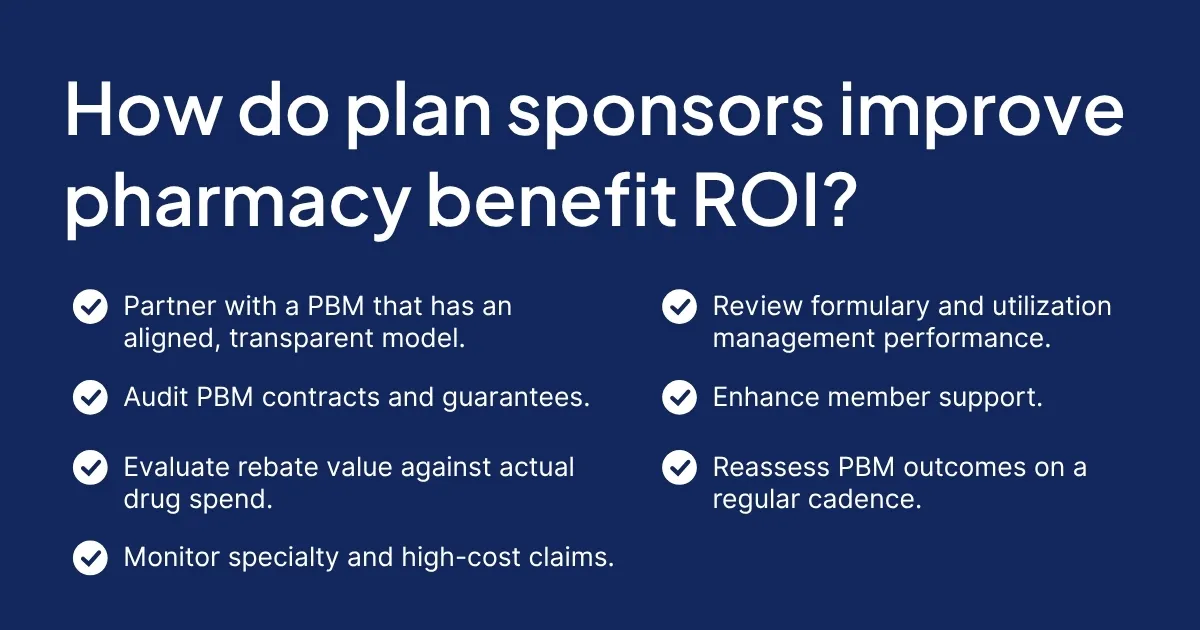
Plan sponsors improve pharmacy benefit ROI by partnering with a PBM whose model aligns with their financial and clinical goals. A transparent, pass-through structure with clear incentives enables better cost control, more accurate performance measurement and stronger member outcomes.
With the right partner in place, plan sponsors can focus on optimizing results through targeted strategies, each with defined ownership, regular review and measurable impact.
1. Partner with a PBM that has an aligned, transparent model.
Choose a PBM whose pricing structure and incentives are fully aligned with your goal of lowering total pharmacy spend. A pass-through PBM with a fixed-fee model earns a clearly disclosed administrative fee instead of generating revenue from prescription prices, retained rebates or affiliated dispensing channels.
Transparency allows you to evaluate true net cost after rebates, discounts, fees and credits. With full visibility, you can compare net PMPM, cost per prescription, drug mix and year-over-year trends, and segment performance across retail, mail-order, specialty and therapeutic categories to identify where savings opportunities exist.
2. Audit PBM contracts and guarantees.
Review the contract against actual invoices, claims, rebate files and reconciliation statements. Confirm pricing definitions, guarantee methodology, excluded drugs, market-check rights, audit access and payment deadlines.
An independent audit can test whether the PBM applied rates correctly and passed through every contracted amount. Benefits teams should document findings, recover missed payments and change unclear language before renewal.
3. Evaluate rebate value against actual drug spend.
Review PBM rebates within the context of total net cost. A large payment can make an expensive drug appear attractive even when a lower-cost therapy would reduce plan spending.
Compare gross price, manufacturer payment, member cost and final plan liability for each major medication. Formulary placement should favor the clinically appropriate option with the lowest net cost.
4. Monitor specialty and high-cost claims.
A single high-cost claim can shift an entire plan year's performance. Track specialty drug pricing at the line-item level, including whether a plan processes each therapy through the medical benefit or the pharmacy benefit, since that split often hides true spend.
Pharmacists should review high-cost claims when clinical circumstances allow. Early oversight identifies biosimilar opportunities, prevents waste and connects eligible members with assistance programs.
5. Review formulary and utilization management performance.
Your drug formulary should steer members toward the lowest-net-cost clinically appropriate option, not the option that generates the largest rebate for the PBM. Track generic use, biosimilar adoption, preferred product utilization, prior authorization results and exceptions.
Utilization rules should protect access while limiting unnecessary spending. Review approval rates, turnaround times and appeals to find requirements that delay care without producing measurable savings.
6. Enhance member support and navigation.
Give employees clear coverage information, cost comparisons and access to pharmacy experts. Better member benefits understanding prevents abandoned prescriptions and reduces avoidable HR escalations.
A pharmacist-led support model helps members find lowest-net-cost medications, enroll in copay assistance and manage side effects before they turn into an emergency room visit or a filled prescription that sits unused.
7. Reassess PBM outcomes on a regular cadence.
Annual reviews catch problems too late. Set a quarterly cadence for reviewing net cost, guarantee attainment and specialty trend, and treat any deviation from target as a reason to ask your PBM for an explanation.
Improve your Pharmacy Benefit ROI with Rightway.
BOOK A DEMOHow to choose an aligned pharmacy benefit manager focused on ROI.
An aligned pharmacy benefit manager’s financial incentives support lower total plan costs and better member outcomes. Instead of earning more when drug prices or rebate volumes increase, an aligned PBM uses transparent compensation and contract terms that tie its performance to the results plan sponsors care about.
When evaluating PBMs, you should look for clear pricing, aligned incentives, verifiable reporting and accountable member service.
Aligned incentives.
Choose a fiduciary-aligned PBM whose business model supports lower costs. Compensation should remain separate from drug prices, rebate volume and pharmacy selection so the PBM does not earn more when plan spending increases.
An aligned PBM should make its compensation easy to understand and its performance easy to verify. Clear economics allow plan sponsors to determine whether each recommendation supports the plan’s financial and clinical goals. Look for financial alignment across the areas that influence coverage and cost decisions:
- A fixed, disclosed administration fee
- Full pass-through of rebates, discounts and manufacturer payments
- No spread pricing on pharmacy claims
- No financial benefit from directing prescriptions to affiliated pharmacies
- Formulary decisions based on clinical value and lowest net cost
Transparent pricing.
A PBM should disclose every source of compensation, including administrative fees, rebates, pharmacy payments, service charges and revenue from affiliated companies.
Review the contract for terms that explain how the PBM calculates and reports costs. The agreement should give your organization access to:
- Ingredient costs and dispensing fees
- Manufacturer rebates and other payments
- Administrative and clinical program charges
- Claim-level reconciliation data
- Complete audit rights
Rightway SureSpend™ uses one disclosed administration fee, 100% rebate pass-through, zero spread pricing and claim-level reporting.
Clear performance reporting.
PBM reports should connect pharmacy spend with utilization, clinical actions, rebates, member costs and contract guarantees. Plan sponsors need consistent definitions, claim-level detail and complete data to validate each result.
Your PBM should explain material changes, identify the source of each variance and track the effect of any action taken. Clear reporting gives benefits teams the evidence needed to hold the PBM accountable and make informed decisions for future planning. A useful performance report should clearly show:
- The medications and categories driving cost growth
- Performance against financial and service guarantees
- Savings generated through clinical interventions
- Recommended actions based on current results
Member-first support.
Evaluate who helps members and whether or not they have the expertise and authority to resolve pharmacy issues. Licensed pharmacists can explain coverage, compare medication options, coordinate prescription transfers and work with prescribers when a therapy change may reduce costs. However, call centers and AI bots may leave members with incomplete answers.
Measure member support through documented service and health plan outcomes. Your PBM should report:
- Average answer and resolution times
- First-contact resolution rates
- Accepted lower-cost medication options
- Member savings and satisfaction
- Abandoned prescriptions resolved
Achieve better ROI from your pharmacy benefits with Rightway.
Rightway PBM helps plan sponsors reduce spend and improve ROI through a transparent, accountable PBM model. Our approach combines lowest-net-cost decision-making, pharmacist-led support and contractual financial protection, giving benefits teams a clearer view of performance and stronger control over outcomes.
Rightway supports better pharmacy benefits ROI through:
- One disclosed administration fee.
- 100% pass-through of rebates and discounts.
- Zero spread pricing
- Pharmacist-led member support.
- Claim-level, audit-ready reporting.
- SureSpend™ pricing model with a contractual pharmacy spend ceiling and full refund of covered overages.
Book a demo today to see how Rightway supports pharmacy benefit ROI improvement through transparency, aligned incentives and better member support.
Frequently asked questions.
An Rx plan performance analysis improves pharmacy benefit ROI by showing which medications, contract terms and utilization patterns drive spend. The review helps plan sponsors compare actual results with guarantees, identify avoidable costs and prioritize actions that can improve future results.