Comparing revenue models in the PBM industry.


Every dollar you spend on pharmacy benefits moves through a pharmacy benefit manager (PBM) first, and how that PBM gets paid shapes what your plan actually spends. The PBM industry runs on four distinct revenue models: traditional, transparent, pass-through, and aligned. These models determine who profits when plan spend goes up, which makes it essential to understand them before signing a contract.
The right revenue model can lower healthcare costs across your plan and reduce what members pay at the pharmacy counter, while the wrong one can increase your pharmacy benefits spend. This piece breaks down how PBMs make money, compares the models operating in the market today, and lays out what you need to understand before you renew or rebid.
Key highlights:
- A PBM model is the financial structure a pharmacy benefit manager (PBM) uses to get paid for administering a prescription drug benefit.
- Legacy PBM models often blend administrative fees with retained rebates and spread pricing that plan sponsors can't fully see in a standard report.
- Four revenue models operate in the PBM industry — traditional, transparent, pass-through, and aligned — and each one changes who profits when plan spend goes up.
- Rightway operates as an aligned PBM with a single administrative fee, 100% rebate pass-through, and guaranteed annual pharmacy spend.
What is a PBM model?
A PBM model is the financial structure a pharmacy benefit manager (PBM) uses to get paid for administering a prescription drug benefit. The model determines where the PBM's revenue actually comes from: a flat fee per member, a share of manufacturer rebates, a markup between what the plan pays and what the pharmacy receives, or some combination of the three.
The revenue model your organization selects affects more than just pharmacy spend. It sets the incentives that decide which drugs land on your formulary, how much of a negotiated rebate reaches your plan, the experience your members have at the pharmacy counter, and whether your PBM profits more when spend rises or falls.
How do pharmacy benefit managers make money with different PBM revenue models?
PBMs can make money in several ways, though which ones apply depends on the revenue model. The sources include:
- Administrative fees
- Pharmaceutical rebates
- Markups between what the plan pays and what the pharmacy receives
- Spreads on retail and specialty claims that most plans never see
Vertical integration adds a further layer for some PBMs by sharing a corporate parent with a major health insurer or owning the specialty and mail-order pharmacies that fill their own members' prescriptions.
That supply chain ownership adds up to real revenue for the PBM and potential costs for plan sponsors and members. The FTC's most recent staff report on PBMs found that pharmacies affiliated with the three largest PBMs generated more than $7.3 billion in dispensing revenue above estimated drug acquisition cost between 2017 and 2022, with markups on some drugs running past 1,000%.
The main revenue models in the PBM industry compared.
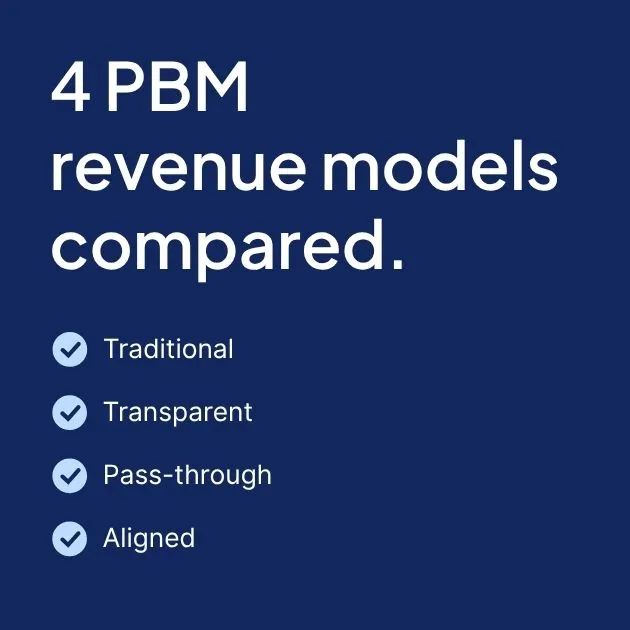
Self-insured plan sponsors have to evaluate different PBM pricing models to determine true net cost and fiduciary alignment, because what a PBM calls its pricing model may not match how they actually operate. Employers are already acting on that gap: three-quarters say they've put their PBM out to bid or plan to, and nearly half have already moved to transparent or pass-through contract structures, according to Willis Towers Watson.
Comparing revenue models requires checking how each model is actually funded. Four questions cut through most of the confusion:
- Where rebate dollars end up
- Whether the PBM owns any part of the pharmacy network
- How much of the contract's economics the PBM discloses
- What the PBM actually earns when your plan's drug spend goes up
Four revenue models operate in the PBM industry: traditional, transparent, pass-through, and aligned, and each one answers these questions differently. Here's how each model actually funds itself:
Traditional PBM models.
Traditional PBMs were long the industry default. The three largest processed roughly 80% of all U.S. prescription claims in 2025, according to the Drug Channels Institute. That scale comes at a cost, though. Favoring high-cost, high-rebate drugs on the formulary is a misleading rebate: it inflates the drug's price so the PBM keeps a larger cut instead of lowering what the plan pays.
Many traditional PBMs also own retail, mail-order, or specialty pharmacies and channel members into them. They also engage in spread pricing, where the PBM charges the plan more for a drug than it reimburses the pharmacy and keeps the difference. Revenue typically comes from pharmaceutical fees, retained manufacturer rebates, program fees, audit fees, and income earned when members fill prescriptions at PBM-owned pharmacies.
Transparent revenue models.
Transparent PBM models emerged directly in response to criticism of traditional PBM opacity. They disclose drug prices, fees, and negotiated rebate terms in the contract, and members typically pay the actual discounted price instead of an inflated list price.
Disclosure alone doesn't align incentives, though: rebates are visible to the employer, but nothing requires the PBM to pass them back in full, and some transparent PBMs still own retail, mail-order, or specialty pharmacies, which can limit member choice and inflate costs. Revenue can include administrative fees, network fees, pharmaceutical fees, a retained portion of rebates, and income tied to owned pharmacy channels.
Pass-through pricing models.
A pass-through PBM commits to sending 100% of negotiated rebates and discounts back to the plan sponsor, charging a separate administration fee instead of keeping a cut of drug savings. In practice, many PBMs that market themselves as pass-through only apply the model to one rebate channel or one part of the contract, which leaves less savings than the label implies.
Pass-through models also tend to concentrate on drug price alone rather than medication utilization or health outcomes, and some still own pharmacy channels that create the same steering risk found in transparent models. Revenue typically comes from per-claim administration fees, clinical administration fees, and, in some contracts, income from owned pharmacy channels.
Aligned PBM models.
An aligned PBM model goes further than transparency or pass-through pricing by removing pharmacy ownership and rebate-driven incentives from the contract entirely, which is what makes it a true fiduciary partnership: no hidden fees, no markups, and no profit-driven motive tied to higher plan spend.
With no ownership stake to protect, nothing pulls volume toward higher-cost drugs or affiliated pharmacies, and members keep the freedom to fill prescriptions wherever works best for them. Revenue comes from an administrative PMPM fee that isn't tied to drug cost or claim volume, plus shared savings when the plan meets agreed-upon targets.
What to evaluate when comparing PBM business models against your plan’s needs.
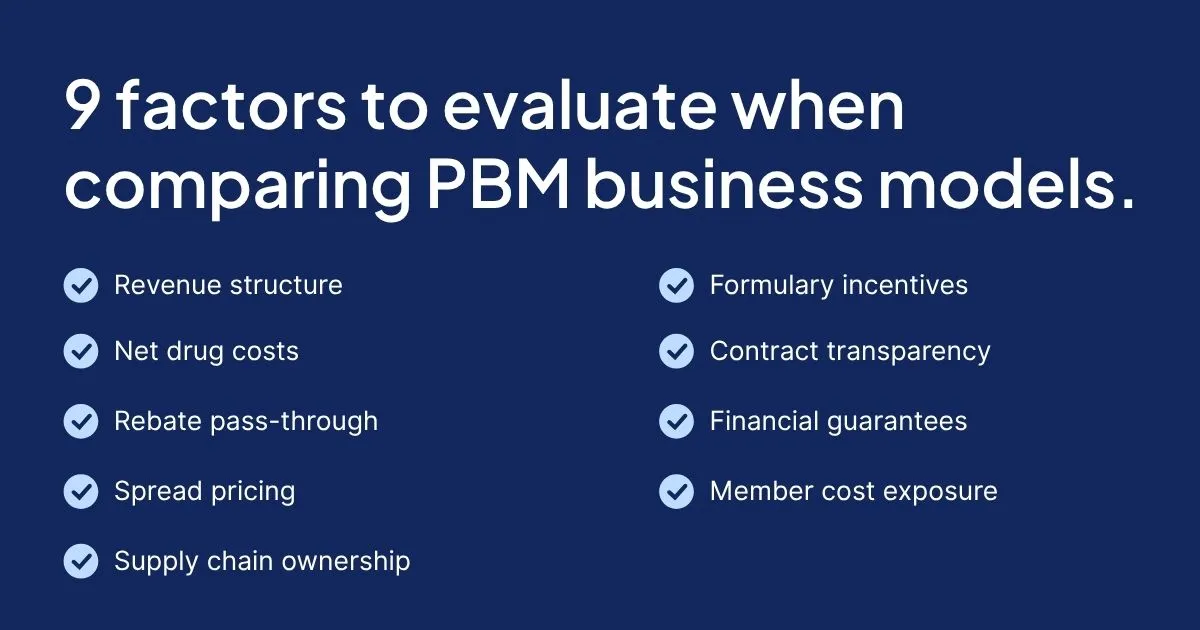
Choosing a PBM business model requires looking beyond headline discounts and rebate guarantees. Plan sponsors should understand how the PBM makes money, what incentives are built into the model, and how those choices affect total pharmacy spend and member costs. These factors can help you compare PBM models and determine which best aligns with your organizations financial and operational priorities.
| PBM model factor to evaluate | What to verify | Why it matters |
|---|---|---|
| Revenue structure | How the PBM earns money: the administrative fee, any rebate share it keeps, and any spread on claims | A PBM paid only a fixed administrative fee has nothing to gain from incentives that drive higher plan spend |
| Net drug cost | The price your plan pays after all rebates and discounts, not the list price | List price alone hides the actual cost driving your pharmacy spend |
| Rebate pass-through | The exact percentage of PBM rebates passed back to your plan | A 100% pass-through commitment closes the gap between what's negotiated and what actually reaches the plan |
| Spread pricing | If there is a contract clause that prohibits spread on retail, mail, and specialty claims | Undisclosed spread inflates cost without appearing as a separate charge |
| Supply chain ownership | Any PBM ownership stake in specialty pharmacies, mail order, or rebate aggregators | Ownership creates a financial reason to steer members toward affiliated pharmacies or entities |
| Formulary incentives | The influence of rebates on your drug formulary, and the possibility of drug reclassification | Rebate-driven, reclassifiable formularies can favor higher-cost drugs over lower-net-cost options |
| Contract transparency | Claim-level reporting rights and audit access | Without audit rights, plan sponsors can't verify what they're actually spending |
| Financial guarantees | A contractual cap on total annual spend, not just a guaranteed rebate percentage | A capped-spend guarantee shifts the financial risk of a bad year from your plan back to the PBM |
| Member cost exposure | The pricing model's effect on member copays and out-of-pocket costs | The revenue model upstream shapes what members pay at the pharmacy counter |
Improve financial alignment with the Rightway PBM model.
Rightway’s PBM solution operates as an aligned PBM, with a single PMPM administrative fee as the only fixed source of revenue, no rebate retention, no spread pricing on any claim, complete transparency, and no vertical integration. Pharmacist-led navigation backs the pricing model with clinical oversight so cost control doesn't sacrifice care quality.
Our SureSpend pricing model adds a contractual ceiling on your annual drug spend: if actual spend exceeds the PMPM spend guarantee, you get the difference refunded, and if spend comes in under the guarantee, your plan keeps the savings.
Give your plan greater control with 100% rebate pass-through, true net-cost pricing, and predictable pharmacy spend. Book a Rightway demo
Get 100% rebate pass-through and predictable pharmacy costs with Rightway.
Book a demoFrequently asked questions.
The best PBM business model for an employer is a fully aligned model. In this model, the PBM earns a fixed administrative fee plus shared savings tied to plan performance, and owns no part of the pharmacy supply chain. That structure removes the two levers other models use to profit from higher drug spend, rebate retention, and pharmacy ownership, so the PBM's incentives point in the same direction as the employer's.