Pharmacy benefit manager companies: A buyer's guide.


Most pharmacy benefit manager companies promise they'll lower your drug spend. Whether that happens depends on the contract terms behind their model, including how rebates are defined, whether pricing is pass-through, and who owns the pharmacies filling your members' prescriptions.
This guide walks through the specific terms to check, the criteria that should rule out a vendor early, and the questions to ask before you sign a multi-year PBM contract.
Key highlights:
- A pharmacy benefit management company builds your drug list, negotiates prices, and pays pharmacy claims on your plan's behalf.
- The vendor with the biggest advertised discount isn't always the cheapest one, because what you actually pay depends on fees, rebates, and network rules buried in the contract, not the number on the sales sheet.
- Rightway charges one flat fee and passes through 100% of negotiated drug rebates to you, instead of marking up prices or keeping a share for itself.
What is a pharmacy benefit management company?
A pharmacy benefit management company is a vendor that administers prescription drug benefits on behalf of employers and health plans. You hire a pharmacy benefit manager (PBM) to build your drug formulary, negotiate pharmaceutical rebates with manufacturers, contract with a pharmacy network, and process claims when your employees fill a prescription.
The PBM sits between the drug manufacturer and the pharmacy counter, and every dollar that moves through that chain, from list price to final reimbursement, passes through the PBM's systems before it shows up on your invoice. That position gives the PBM significant control over your total drug spend, which is exactly why the terms of the contract matter as much as the vendor's reputation.
Why you need to compare pharmacy benefit manager companies.
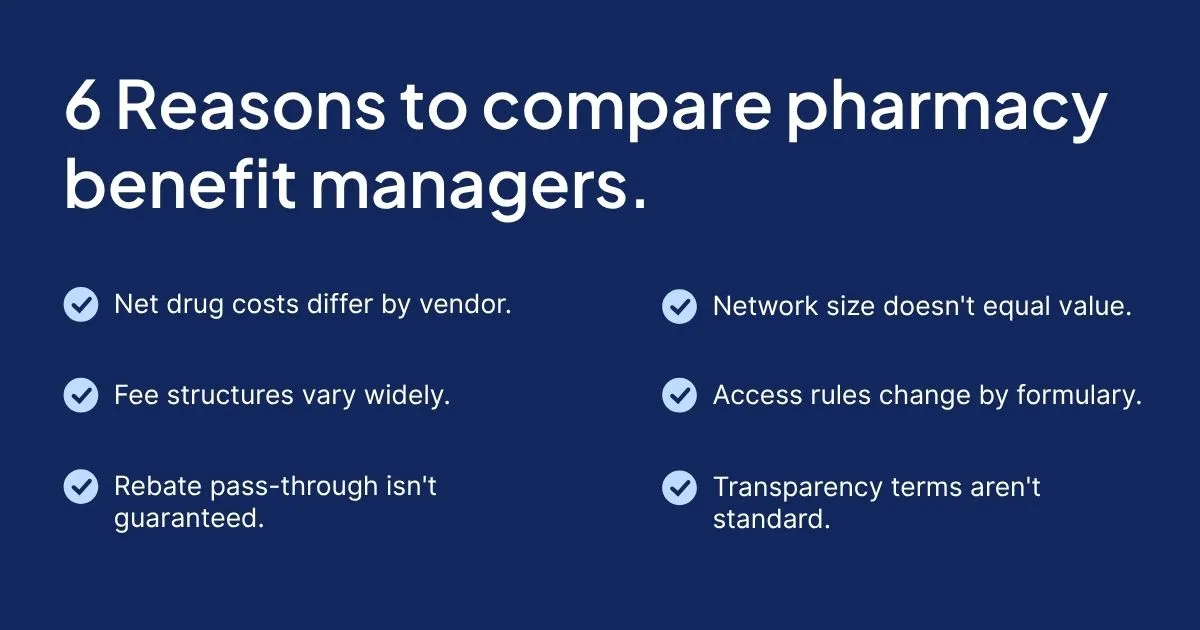
Nearly 43% of employers are considering a PBM switch within the next one to three years, according to the National Alliance of Healthcare Purchaser Coalitions. You need to compare pharmacy benefit manager companies to control drug spend because pricing terms, rebate treatment, and network design vary widely between vendors. Two PBMs quoting the same discount percentage can produce very different total plan costs once you account for fees, rebate retention, and utilization.
The reasons to compare PBMs include:
- Net drug costs differ by vendor: Compare net cost per claim, not the headline AWP discount. A deeper discount on an inflated list price can still cost more than a smaller discount on a fair one.
- Fee structures vary widely: Ask each vendor to itemize every fee source: administrative fees, data fees, clinical program fees, and anything charged per claim.
- Rebate pass-through isn't guaranteed: Confirm whether you receive 100% of negotiated rebates or a negotiated share. That single term can shift the total plan cost by millions for a large employer.
- Network size doesn't equal value: Scale alone doesn't lower drug prices. Real savings depend on how transparent the pricing model is and how much of that negotiated discount actually reaches your plan instead of staying with the PBM.
- Access rules change by formulary: Drug formulary restrictions and prior authorization rules affect whether your employees get the medication their doctor prescribed without delay.
- Transparency terms aren't standard: A PBM that resists sharing claims-level data or blocks independent audits usually has spread pricing or retained rebates it doesn't want you to find.
Building a comparison around these six factors is the foundation of reviewing better pharmacy benefit management strategies.
How to choose from the top pharmacy benefit management companies: 6 steps to a transparent contract.
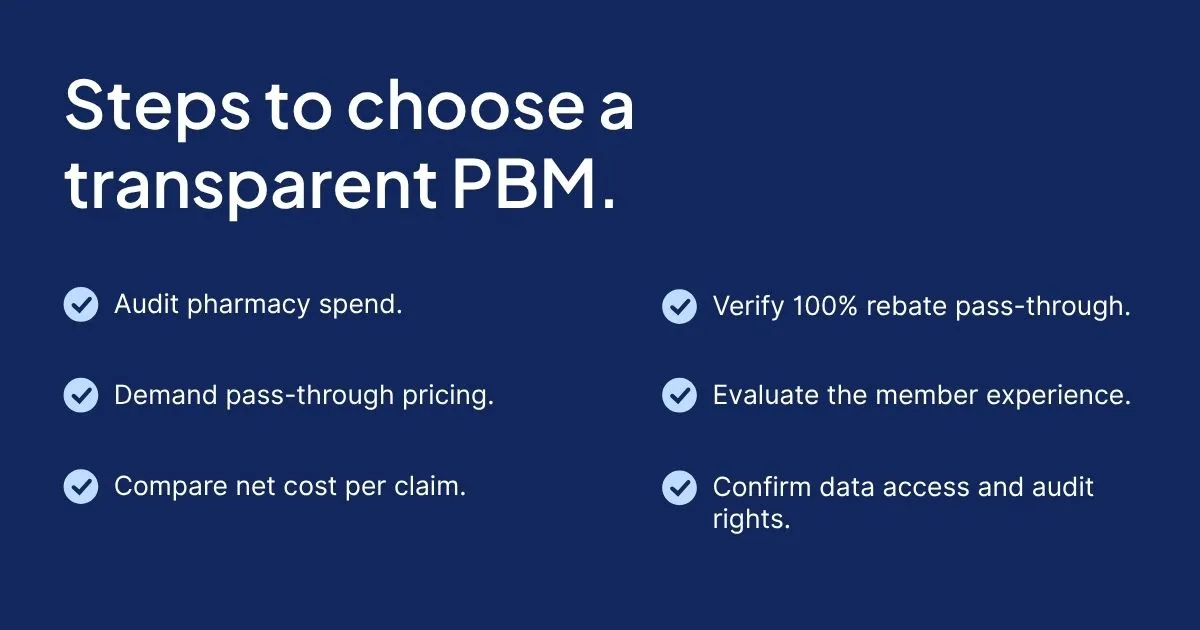
Choosing among the top pharmacy benefit management companies works best with one consistent framework applied to every vendor. Run each contender through the same six checks, and use the results to decide who moves to the next round.
1. Audit your current pharmacy spend and top drug utilizers.
Pull 12 to 24 months of claims data before you talk to a single vendor. Identify which drugs and which members drive the largest share of spend. Specialty drugs are projected to account for more than 60% of total pharmacy spending in 2026, despite representing fewer than 5% of total prescriptions, according to Drug Topics. Effective specialty drug management can lower this spend driver.
2. Demand a pass-through contract with every fee defined.
Reject any agreement built on spread pricing or an undefined markup. A pass-through PBM charges you exactly what it pays the pharmacy, plus a disclosed, flat administrative fee, with both numbers appearing as separate line items rather than bundled into one discount rate. If a vendor can't show you that math clearly, or resists breaking it down at all, keep looking.
3. Compare net cost per claim, not headline discounts or rebate guarantees.
An AWP discount guarantee or a rebate estimate can look attractive while masking a higher real cost. Calculate net cost per script, including every fee and the member copay, across all vendors under evaluation. That number gets you closer to lowering healthcare costs than any discount percentage shared during a sales pitch.
4. Verify 100% rebate pass-through in writing.
Get the exact contract language that defines what counts as a rebate, and confirm the definition captures administrative fees, inflation protection payments, and value-based manufacturer incentives beyond the standard PBM rebates tied to formulary placement. Ask for verification that every rebate dollar collected is passed through to your plan.
5. Evaluate the member experience.
Ask for a live demo of the member app and a walkthrough of how a pharmacist actually helps a member choose a lower-cost drug or manage a specialty medication. Find out who actually answers the phone: a pharmacist with access to the member's full medication history, or a call center representative reading from a script. Strong clinical navigation prevents savings from being erased by unnecessary utilization.
6. Confirm claim-level data access and audit rights.
Audit rights and reporting frequency show whether a PBM contract holds up after signing. About 23% of employers using one of the three largest PBMs say they aren't sure what's actually in their own contract, compared with 12% of employers using other PBMs, according to the National Alliance of Healthcare Purchaser Coalitions. A transparent PBM contract includes full third-party audit rights and frequent claims reporting, not an annual summary.
4 criteria for building a pharmacy benefit management companies list.
Before you issue an RFP, run every prospective PBM vendor through a short set of qualification filters. Self-funded employers and benefit advisors who skip this step can spend months evaluating PBMs that never had a real chance of fitting the plan. A tight pre-RFP screen narrows your pharmacy benefit management companies list to vendors worth the deeper review, and it gives your broker a defensible reason to exclude a vendor before the finalist round instead of after months of demos.
| PBM screening criteria. | Keep on the list. | Cut from the list. |
|---|---|---|
| 1. Business model | Pass-through pricing with one disclosed flat fee | Spread pricing or a percentage-based fee structure |
| 2. Vertical integration | No supply chain ownership, including manufacturing, health plans, pharmacies, or specialty distribution | Steers members to their own mail-order or specialty pharmacy |
| 3. Member experience | Pharmacist-led support with easy-to-use technology | Call center model with no clinical staff involved in member support |
| 4. Transparency | Pricing methodology, fee structure, and rebate treatment disclosed with audit rights given | Undefined terms, broad rebate retention clauses, and spread pricing buried in claims data, with no ability to verify actual drug costs or savings |
Choose Rightway as your transparent pharmacy benefit management company.
Rightway's PBM solution is a pass-through alternative to a market built on spread pricing and retained rebates. With Rightway, you pay the exact amount we reimburse the pharmacy for each claim, plus one flat administrative fee, and you keep 100% of the negotiated rebates.
This predictable cost structure runs on our SureSpend pricing model, which keeps your plan's costs consistent from month to month instead of shifting with drug mix or utilization. Pharmacists lead the clinical support behind the model, guiding members toward the lowest-cost medication and channels.
Book a demo to see how Rightway can help you build a more transparent, predictable pharmacy benefits strategy.
Improve pharmacy benefits transparency and predictability with Rightway.
Book a demoFrequently asked questions.
The warning signs of a misaligned pharmacy benefit management company contract show up in the underlying structure. Watch for:
- Spread pricing built into the fee structure instead of one flat, disclosed fee
- Rebate retention, where the PBM keeps a share of manufacturer rebates instead of passing through 100%
- Vertical integration, where the PBM owns pharmacies, specialty distributors, or rebate aggregators inside its own network
- Restricted or delayed access to claims-level data and audit rights