How employers can ensure transparent PBM contracts.


Employers can ensure transparent PBM contracts by requiring pass-through pricing, full audit rights, unrestricted claims data access, and contract language that defines every key term in writing. Each requirement closes a specific loophole that legacy pharmacy benefit managers use to keep costs hidden from the plan sponsors paying the bill.
When a pharmacy benefit manager (PBM) contract skips these protections, the plan pays for the gap. Costs shift into spread pricing, undisclosed fees, and rebate structures that reward the PBM when pharmacy spend increases. A transparent pharmacy contract gives the employer visibility into where that money goes and control over the terms that determine how much of it comes back as savings.
Key highlights:
- A transparent pharmacy contract makes PBM economics verifiable by clearly defining pricing, rebates, fees, claims data, and performance terms and opening them to independent review.
- Employers can strengthen PBM contracts by putting transparency requirements in writing, including 100% rebate pass-through, no spread pricing, full audit rights, unrestricted claims data, revenue disclosure, and enforceable guarantees.
- Rightway passes through 100% of rebates, owns 0% of the pharmacy supply chain, uses a neutral formulary, and gives plan sponsors claims-level visibility into pharmacy spend.
What is a transparent pharmacy contract?
A transparent pharmacy contract is a pharmacy benefit manager (PBM) agreement that clearly defines what the PBM charges, how it earns revenue, what happens to rebates and discounts, and what data the employer can access to verify performance. That level of clarity matters because a PBM influences drug pricing, formulary placement, pharmacy networks, and claims processing. The contract determines whether those decisions create value for the plan or additional revenue for the PBM.
Those questions are increasingly important as pharmacy costs rise. Pharmacy represented 24% of employer healthcare spending in 2024, and employers projected pharmacy costs to go up another 11% to 12% in 2026, according to Business Group on Health. Transparency should make those costs easier to understand and manage.
What are the risks of non-transparent PBM agreements?
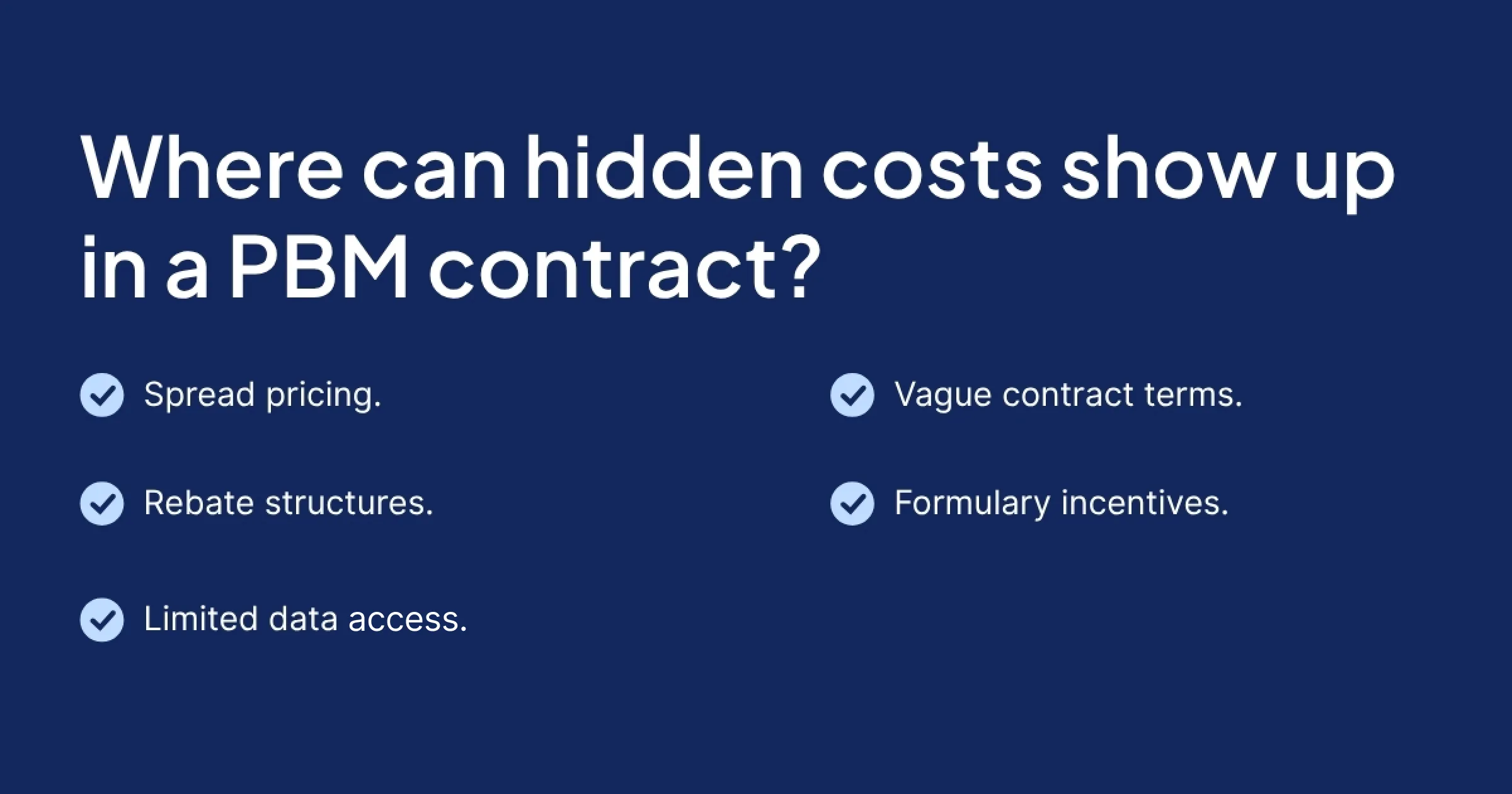
When a PBM contract lacks pass-through pricing, full data access, and clearly defined terms, the costs do not disappear. They can move into parts of the pharmacy benefit that are difficult for a plan sponsor to see or verify.
The risks of not partnering with a transparent PBM become clearer when you look at the specific contract structures that allow hidden margins or conflicting incentives to survive.
- Spread pricing that hides what you actually pay: The Federal Trade Commission found that the three largest PBMs earned an estimated $1.4 billion from spread pricing on specialty generic drugs alone, billing plan sponsors more than they reimbursed pharmacies for the same claims. Without a contract that bans spread pricing outright, an employer has no way to confirm the price paid matches the price billed.
- PBM rebate structures that reward volume over member savings: A rebate can lower pharmacy spend when 100% of the value is returned to the plan. However, a PBM that keeps a share of manufacturer rebates has a financial incentive to favor drugs with the largest rebate, not the lowest net cost.
- Locked-away claims data and limited audit rights: The National Alliance of Healthcare Purchaser Coalitions' 2026 Pulse of the Purchaser survey found that nearly one in four employers using a Big 3 PBM said they weren't sure what their own contract contained, roughly double the rate among employers using other PBMs. Without direct claims access, a plan sponsor is reviewing a summary the PBM chose to provide, not the underlying data.
- Vague contract language and undefined key terms: Words like "generic," "rebate," and "AWP" carry no fixed legal meaning unless the contract defines them. A PBM operating under undefined terms can reinterpret them mid-contract in its own favor, and the plan sponsor has no clause to point to when costs shift.
- Drug formulary decisions steered by misaligned incentives: A formulary built around rebate size, rather than net cost, routinely places higher-priced brand drugs ahead of clinically equivalent, lower-cost alternatives. Employers rarely see this trade-off until claims data shows it after the fact.
How to choose transparent and ethical PBMs without hidden contract clauses.
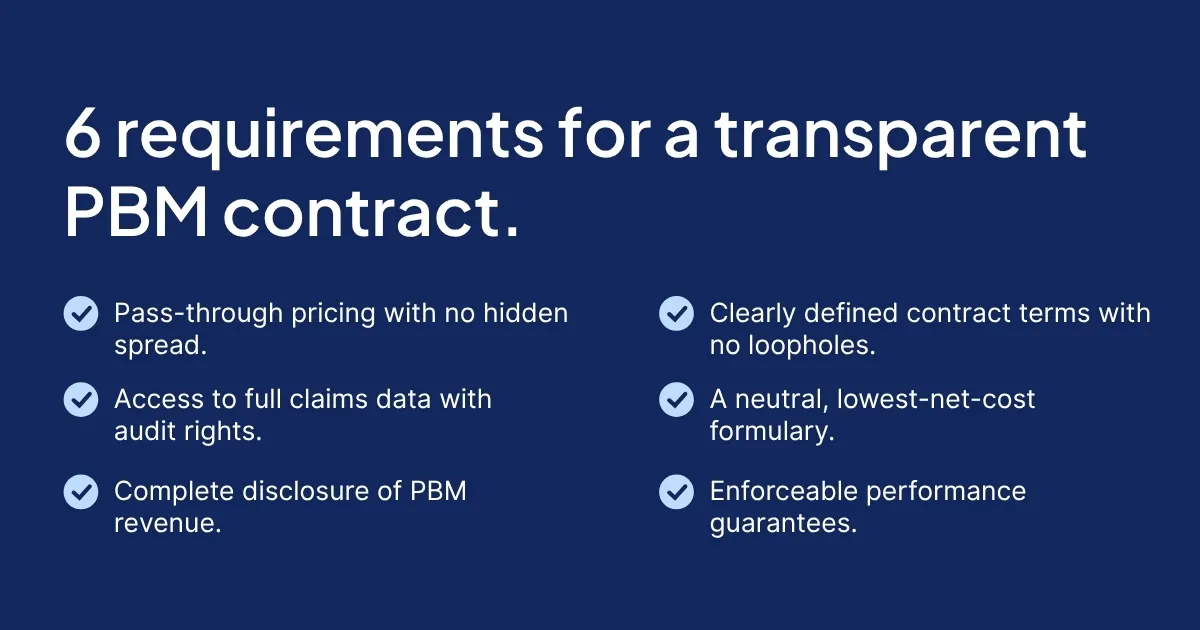
Choosing transparent and ethical PBMs without hidden contract clauses comes down to what an employer writes into the agreement, not what a PBM promises verbally during the sales process. These six moves turn transparency from an unverified promise into enforceable contract terms.
1. Require pass-through pricing that shows exactly what you pay.
A transparent PBM should make it clear what the pharmacy was paid, what the plan was charged, and where rebates and discounts went. Look for a pass-through PBM model with no spread pricing and 100% of rebates returned to the plan, so the PBM does not profit from hidden differences in drug costs.
Also, look closely at how the PBM defines pass-through pricing in the contract. Some models may appear transparent at a high level while still allowing margin through certain claim types, pharmacy channels, or fees. The pricing model should apply consistently across retail, mail-order, and specialty pharmacy claims.
2. Secure full audit rights and unrestricted claims data access.
Employers should have unrestricted access to claims data and the right to independently audit the PBM's pricing and performance. A PBM that limits data access or places heavy restrictions on audits makes it harder to verify whether the contract is delivering what was promised.
Ask what data will be available, how often it will be provided, and whether it includes the detail needed to trace costs down to the claim level. Audit rights should also allow employers to use an independent auditor and review the records needed to validate pricing, rebates, fees, and guarantees.
3. Demand disclosure of every revenue stream and conflict of interest.
A transparent PBM should disclose every source of revenue tied to your plan, including administrative fees, manufacturer payments, rebate-related revenue, and income connected to affiliated pharmacies or other businesses.
Clear revenue disclosure makes it easier to see whether the PBM's incentives are aligned with lowering your pharmacy costs. With a fiduciary-aligned PBM, the PBM's revenue does not increase when drug prices, rebate values, or specialty pharmacy utilization increase. The simpler and more visible the compensation model is, the easier it is to evaluate alignment.
4. Define every key term in writing to close contract loopholes.
Transparent PBMs provide contract clarity without loopholes by clearly defining terms such as “rebate,” “generic,” “specialty,” and “average wholesale price,” rather than leaving room for interpretation.
The agreement should also spell out pricing, fees, data rights, and other financial terms in language that can be consistently applied throughout the contract. Pay attention to provisions that allow the PBM to change definitions, pricing methodologies, or drug classifications during the contract term. A transparent agreement should limit unilateral changes that could materially alter the economics.
5. Insist on a neutral formulary free of manufacturer incentives.
A PBM's formulary should prioritize clinical appropriateness and the lowest net cost, not the drug that generates the largest rebate or benefits an affiliated business.
Look closely at ownership relationships and other financial incentives that could influence which medications, pharmacies, or channels the PBM recommends. Employers should also understand how formulary decisions are made, how often the formulary changes, and whether the PBM can demonstrate that preferred drugs are selected based on clinical value and total net cost.
The difference between open and closed formulary.
6. Lock in performance guarantees and clean termination rights.
The contract should carry enforceable savings and service guarantees alongside clean termination rights, so a missed target has a real consequence and a bad fit has a clear exit. A PMPM spend guarantee is one way to put a number behind that promise. A transparent partner should be willing to put both its financial model and its performance commitments in writing.
What should employers look for when negotiating a transparent pharmacy contract with a PBM?
Employers negotiating a transparent pharmacy contract should focus on terms they can independently verify: actual pharmacy pricing, complete rebate pass-through, unrestricted data, disclosed revenue, neutral formulary incentives, and enforceable accountability.
This checklist gives plan sponsors a practical set of requirements to bring to the negotiating table.
| PBM contract element | What to require | Why it matters |
|---|---|---|
| Pricing model | Pass-through pricing with 100% of rebates returned | Pass-through pricing gives employers a clear view of the actual cost of each claim and ensures negotiated savings flow directly back to the plan. |
| Data access | Unrestricted claims data and full audit rights | Without direct access to claims data, employers can't verify pricing accuracy or catch billing errors before they compound. |
| Revenue disclosure | Written disclosure of every revenue stream and fee | Undisclosed fees, like admin charges or rebate aggregation, are where hidden margin survives inside a "transparent" contract. |
| Contract language | Defined terms for "generic," "rebate," and "AWP" | Vague or undefined terms let a PBM reinterpret them mid-contract in its own favor. |
| Formulary control | Neutral formulary built on the lowest net cost | A PBM with ownership ties to a pharmacy or manufacturer has an incentive to favor higher-rebate drugs over lower-cost ones. |
| Accountability | Performance guarantees and clean termination rights | Without guarantees, there's no consequence when savings or service targets are missed, and no easy way out if they are. |
Lock in a transparent contract with Rightway’s neutral PBM.
Rightway's PBM model is built around transparent economics and financial alignment. Through Rightway's PBM solution, employers receive 100% rebate pass-through, zero spread pricing, claims-level reporting, and a single, transparent administrative fee. Rightway also owns 0% of the pharmacy supply chain, removing the financial incentive to steer members toward an affiliated pharmacy.
Those economics are paired with pharmacy navigation and clinical support. Licensed pharmacists can help members navigate medication questions, identify clinically appropriate lower-cost alternatives, and work through pharmacy benefit issues. Because formulary decisions are designed around clinical value and net cost rather than retained rebate revenue, the financial model and clinical model work toward the same goal.
Get full audit rights, claims data access, and complete visibility into your pharmacy spend with Rightway’s pass-through PBM. Book a demo.
See how Rightway’s pass-through PBM delivers transparent contracts.
Book a demoFrequently asked questions.
The red flags in a non-transparent pharmacy benefit contract are:
- Spread pricing
- Retained or narrowly defined rebates
- Limited claims data access
- Restricted audit rights
- Vague definitions
- Undisclosed revenue streams
- Conflicts created by pharmacy ownership
- Formulary decisions that can’t be tied back to clinical value and lowest net cost
Employers should also watch for contract provisions that let the PBM reclassify drugs or change financial definitions during the agreement, restrict independent auditors, or impose expensive termination provisions.