The generic drug pricing game: What employers need to know.

Generic drug pricing strategies offer a major source of potential savings, but lower prices do not always translate into reduced costs for employers and members. Pharmacy benefits manager (PBM) pricing practices, formulary decisions and contract terms can all affect how much of that value flows back to the people paying for the plan.
Key highlights:
- Generic medications are lower-cost alternatives to brand-name drugs that must meet approval standards for bioequivalence, strength and intended use.
- The savings generated from generic options depend on how the PBM structures reimbursement, formulary design and contract terms.
- Opaque generic drug pricing can conceal deceptive cost structures, copay clawbacks and incentive-driven decisions that increase spending for plans and members.
- Rightway’s 100% pass-through model eliminates PBM spread pricing, retained rebates and hidden incentives so more savings flow back to plans.
What are generic medications?
Generic medications are drugs that are identical to brand-name versions in dosage, strength, safety, effectiveness and quality, but are sold at a lower cost. They become available once the patent for a brand-name medication expires, allowing other manufacturers to produce and market the same medication. For example, Motrin is the brand name for ibuprofen, Claritin for loratadine and Lipitor for atorvastatin.
Generic medications are cheaper than brand-name medications despite their identical therapeutic benefits. That's because manufacturers don’t need to complete the original research, clinical trials and marketing that brand-name makers have already invested in. Competition among multiple approved vendors also drives the cost down further.
Get the full benefits of generic medications for your health plan.
Are generic medicines less effective?
Generic medications are not less effective, as they must be shown to be bioequivalent to the reference drug before they are approved for sale. This means the body absorbs the medication at a comparable rate and to a comparable extent, so it is expected to provide the same clinical benefit.
To receive approval, the product must also match the reference drug in several key ways, including:
- Strength
- Dosage form
- Route of administration
- Intended use
A pharmaceutical quality analysis published by Frontiers in Pharmacology found that 131 samples of 22 essential medicines across eight therapeutic categories met all standards, indicating equivalence between branded and generic versions.
Cost difference between generic and brand-name drugs.
The savings created by generic competition can be substantial. In fact, the U.S. Food and Drug Administration (FDA) reported that the 773 new lower-cost medication options approved in 2023 generated a net $18.6 billion in savings in 2024.
Across common maintenance medications, the generic version routinely costs 85% to 99% less per unit than the brand it replaced:
| Brand-name drug. | What it’s used to treat. | Pre-expiry price per unit.* | Cost of generic medications. | Modeled savings. |
|---|---|---|---|---|
| Glucophage (Metformin). | Type 2 diabetes | $0.66 | $0.03 | 85% |
| Lipitor (Atorvastatin). | High cholesterol and cardiovascular risk reduction | $3.29 | $0.06 | 97% |
| Norvasc (Amlodipine). | High blood pressure and chest pain | $1.54 | $0.02 | 99% |
| Prilosec (Omeprazole). | Acid reflux | $3.31 | $0.06 | 98% |
*The drug costs in this table were sourced from the Association of Accessible Medicines'2025 U.S. Generic and Biosimilar Medicines Savings Report.
The benefits of reduced generic medicine costs are only fully realized when your pharmacy benefits manager prioritizes these options. A solution like Rightway, with a 100% pass-through model, lets you avoid formulary-based decisions shaped by rebate revenue and eliminates the markups that would otherwise erode these discounts.
What is a generic effective rate in PBM pricing?
A generic effective rate (GER) is a contractual reimbursement target that a PBM vendor applies across a group of generic drug claims, often expressed as a function of the Average Wholesale Price minus a percentage. Rather than establishing the final reimbursement for each prescription, a GER measures whether payments across the full group meet the agreed rate over a set period.
For example, a contract might require generic claims to average 85% below the average wholesale price. One medication could be reimbursed at a 70% discount and another at a 95% discount, as long as the claims collectively meet the 85% target. PBMs may adjust maximum allowable cost prices or pharmacy fees to reach that rate. Because the guarantee is measured in aggregate, it can obscure the reimbursement and margin associated with prescriptions.
How traditional PBMs distort the cost of generic medications.
Behind the scenes, legacy pharmacy benefits managers inflate the cost of generic medications, sometimes marking them up by as much as 20%, according to the USC Schaeffer Institute for Public Policy & Government Service. These self-serving pharma pricing strategies drive up costs, restricting access to necessary medications for both employers and their teams.
Many vendors use PBM rebate schemes along with deceptive formulary designs to prevent consumers from benefiting from the savings these medications offer.
Hidden markups.
Generic pricing can be difficult to evaluate when the amounts charged to the plan, paid by the member and reimbursed to the pharmacy are not fully disclosed. Common tactics include:
- Copay clawbacks: When a member fills a generic prescription, the copay they pay at the counter can be higher than what the drug actually costs the pharmacy.
- PBM spread pricing: The pharmacy benefits manager charges the plan sponsor more for a generic medication than it reimburses the pharmacy, then keeps the difference.
Opaque formularies.
Formulary design can shape which medications are easiest and most affordable for members to access. Traditional PBMs may use that control in ways that limit generic options, including:
- Deprioritizing generics: PBMs negotiate rebates from drug manufacturers to prioritize high-cost options in their drug formularies. Because generic manufacturers typically offer smaller incentives, brand names may be favored to maximize income.
- Excluding low-cost options: Pharmacy benefit managers might exclude generic drugs from their formularies altogether. This forces patients to either pay it themselves or navigate a complex appeals process for coverage.
The impact of inflated generic drug prices on employers.
Inflated generic prices can increase total spending even when plan members are using medications intended to lower pharmacy costs. Employers may face:
- Less predictable budgets
- Higher plan expenses
- Greater out-of-pocket costs for employees
Employers often struggle to understand PBM profit mechanisms and how much of the savings from generics are actually passed on to them. This lack of transparency into drug pricing models puts benefit administrators at a significant disadvantage during negotiations.
Without a clear understanding of the true cost of medications, leaders cannot secure favorable terms or make informed pharmacy decisions for their teams.
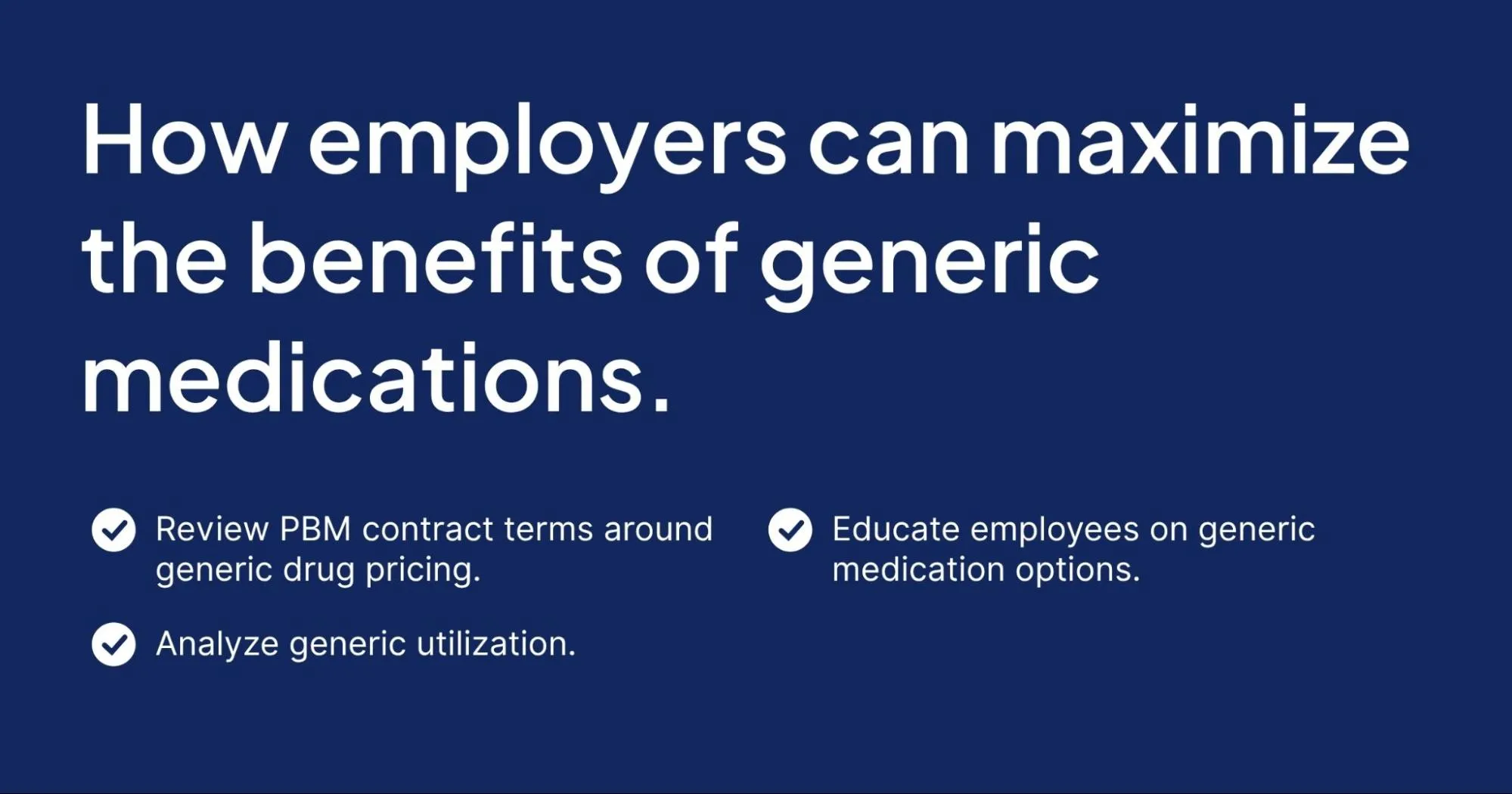
How employers can maximize the benefits of generic medications.
Employers do not have to accept opaque generic pricing as an unavoidable part of their pharmacy benefit. Here are three strategies plan sponsors can use to ensure they get the most out of their plans:
1. Review PBM contract terms around generic drug pricing.
Understanding the role of your PBM in setting and administering generic drug prices is critical. Ensure your contract clearly defines how generic claims are priced, including whether the PBM can charge the plan more than it reimburses the pharmacy. Claims-level reporting and regular audits can help identify spread pricing, undisclosed markups and other practices that may prevent the plan from realizing the full savings associated with generic medications.
2. Analyze generic utilization.
Assess the use of generics in your plan to identify opportunities for improvement. Work with your PBM to implement formulary designs that prioritize low-cost equivalents and encourage their use over brand-name drugs.
3. Educate employees on generic medication options.
Communicate the benefits of choosing generics over brand-name drugs to your employees. Inform them about cash-pay options for generics, such as Mark Cuban Cost Plus Drugs, which can be significantly cheaper than using insurance coverage.
Capture the full savings on generic drugs with Rightway.
Capturing the full generic savings comes down to how your pharmacy benefits manager is paid. Rightway PBM eliminates the spread pricing, retained rebates and copay clawbacks that erode those discounts, so the value of every generic prescription reaches your plan instead of disappearing into markups.
Book a demo today and see how Rightway's 100% pass-through model gives you full visibility into every generic drug claim and the pricing behind it.