Navigating fiduciary responsibility: Why an aligned PBM matters.


Every time a pharmacy benefit manager (PBM) applies an undisclosed markup, holds back part of a rebate, or reclassifies a routine prescription as a specialty drug, the plan absorbs the cost, and employees may pay through higher premiums or out-of-pocket expenses. For most employers, this used to be a compliance footnote. It's now a pharmacy budget problem that HR and finance both have to answer for.
A fiduciary PBM closes that gap by tying its own incentives to the employer's, through transparent pricing and full rebate disclosure. This article breaks down what fiduciary duty requires, where traditional PBM practices erode pharmacy budgets, and what to look for in a PBM built to protect them.
Key highlights:
- PBM fiduciary responsibility means plan fiduciaries must oversee pharmacy benefits and make decisions that serve the interests of plan participants and beneficiaries.
- A fiduciary-aligned PBM can help employers protect their pharmacy budgets through transparent pricing, aligned incentives, clear rebate terms, and ongoing cost oversight.
- Rightway's PBM model is designed to align its compensation with plan sponsor cost-control goals, helping employers gain greater visibility into pharmacy spending and make more informed benefit decisions.
What is PBM fiduciary responsibility?
PBM fiduciary responsibility is the legal duty employers take on under the Employee Retirement Income Security Act (ERISA) when selecting and overseeing a pharmacy benefit manager (PBM) or their health plan. It requires employers to act in the best interests of plan participants, rather than prioritizing convenience or a vendor's marketing claims. That duty includes evaluating drug pricing, rebate disclosures, compensation, and reporting practices.
The Consolidated Appropriations Act (CAA) reinforces transparency requirements around health plan costs. In practice, meeting fiduciary duties means understanding how a pharmacy benefits partner is compensated and whether its pricing model creates incentives that could increase costs.
Why PBM fiduciary duty matters for employers.
PBM decisions affect an employer's pharmacy spending and what employees pay for medications. Employers need visibility into pricing, vendor compensation, and whether the arrangement serves the plan's financial interests. Without that oversight, cost drivers and conflicts of interest can go unnoticed.
A fiduciary-aligned PBM supports stronger oversight through transparent, pass-through PBM pricing, clear compensation terms, and full rebate disclosure. These practices give employers real visibility into pharmacy spending, so they can make informed decisions about controlling costs and protecting their pharmacy budget.
How traditional PBM practices threaten employer pharmacy budgets.
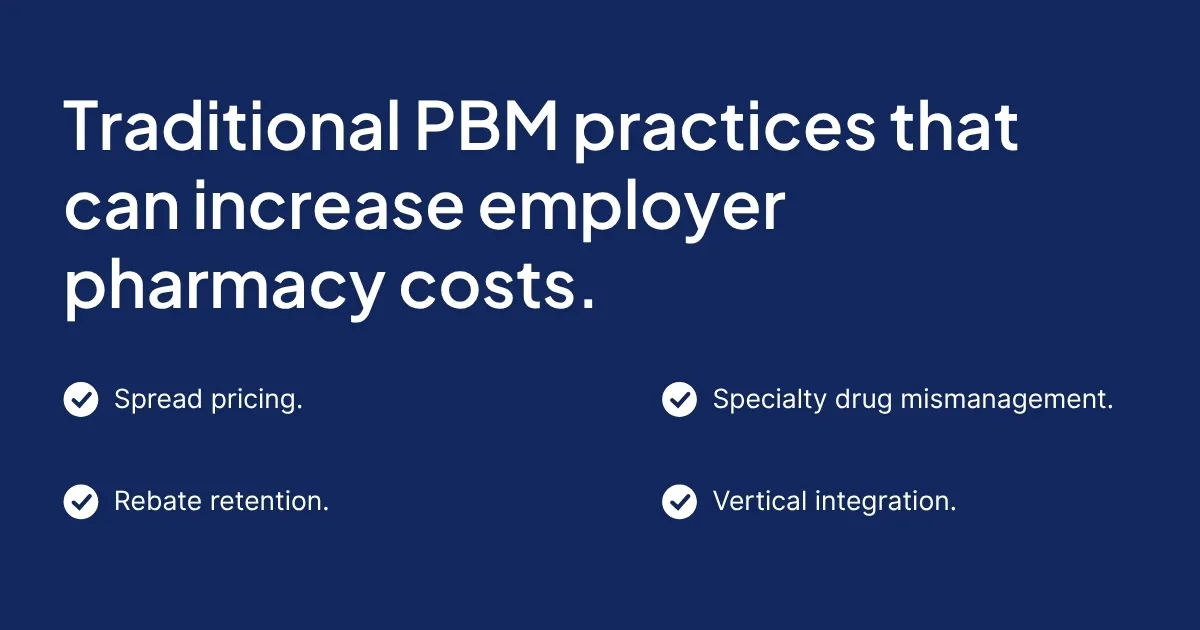
Not all PBMs use the same pricing and revenue models, so employers should understand how these arrangements affect pharmacy spend. Practices such as spread pricing, rebate retention, specialty drug management, and vertical integration can limit transparency or create incentives that conflict with cost-control goals.
Review these practices when evaluating a PBM's contract and performance:
Spread pricing adds undisclosed markups to prescription claims.
Spread pricing occurs when a PBM charges the plan more for a prescription than it pays the dispensing pharmacy and retains the difference. For example, a PBM could pay a pharmacy $100 for a medication and charge the plan $150, retaining the $50 spread. Without clear contract terms and reporting, employers may have limited visibility into these markups and their impact on total pharmacy spend.
Rebate retention distorts formularies toward higher-priced drugs.
Manufacturer rebates can reduce a plan's net costs, but the amount an employer receives depends on its contract. Plan sponsors should check whether rebates are fully passed through, how they are calculated, and whether any portion is retained by the PBM or another party.
Clear PBM rebate terms and reporting help plan sponsors evaluate the true net cost of their pharmacy benefit.
Specialty drug reclassification forces high-cost channel steering.
Specialty drugs can represent a significant share of pharmacy spending, making their management an important part of budget oversight. Employers should check:
- How their PBM defines this category
- Which pharmacies can members use
- How these medications are priced
- Whether the PBM has financial relationships with specialty pharmacies
Reviewing these factors can help identify potential cost drivers and determine whether channel management supports cost-control goals.
Vertical integration creates misaligned supply chain incentives.
PBM vertical integration occurs when a pharmacy benefit manager is affiliated with other parts of the pharmacy supply chain, such as retail, mail-order, or specialty pharmacies. PBM-affiliated pharmacies captured 68% of specialty drug dispensing revenue in 2023, up from 54% in 2016, according to a Federal Trade Commission report, so these arrangements can affect where prescriptions get filled.
Affiliations between PBMs and pharmacies don't automatically make an arrangement unfavorable, but they can create potential conflicts that warrant closer review.
How employers uphold fiduciary duty and protect pharmacy budgets.
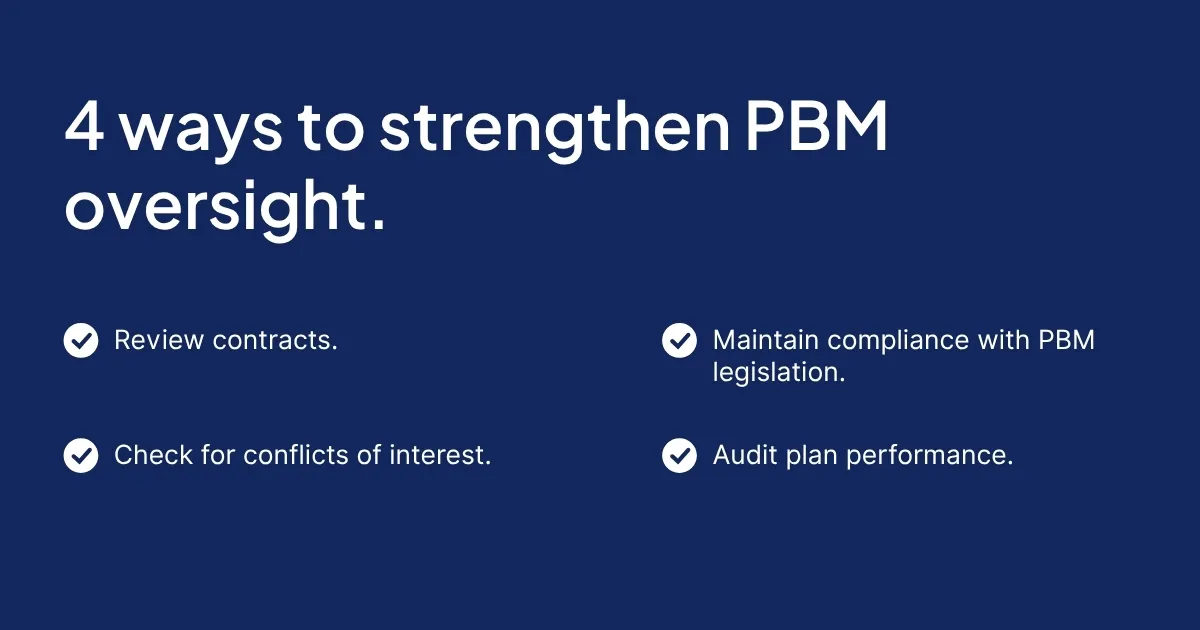
Fiduciary oversight requires employers to evaluate the cost, terms, and incentives of their pharmacy benefit arrangement. These practices can help you strengthen oversight, identify potential cost drivers, and protect your pharmacy budgets over time.
1. Conduct regular contract reviews and benchmark drug pricing.
PBM pricing and rebate terms can change over the life of a contract, so regular reviews, including at renewal, are essential. Focus on:
- Drug pricing and administrative fees
- Rebate terms and guarantees
- Audit and reporting rights
- Other provisions that affect total pharmacy spend
Benchmark net costs against current market rates to identify unfavorable terms or pricing changes.
2. Evaluate consultant recommendations for hidden PBM conflicts of interest.
Benefits consultants and brokers may receive commissions, bonuses, or other compensation from vendors they recommend. Request written disclosure of any direct or indirect financial relationships with proposed PBMs, including ownership interests or preferred vendor arrangements, and factor those relationships into the selection process.
3. Maintain strict compliance with ERISA and CAA transparency mandates.
Document the fiduciary process for evaluating and overseeing the pharmacy benefit, including PBM compensation, pricing, contracts, and potential conflicts of interest. The CAA includes requirements related to access to plan data, gag clauses, and prescription drug cost reporting, while ERISA requires fiduciaries to act and ensure plan service arrangements are reasonable.
Work with qualified legal or benefits advisors to identify the requirements that apply to the plan and confirm that contracts and oversight processes support compliance.
4. Audit pharmacy plan performance against annual market trends.
Drug pricing and rebate benchmarks shift every year, most recently driven by rising GLP-1 utilization, which Segal's 2026 Health Plan Cost Trend Survey identifies as a top driver behind an 11% projected increase in prescription drug costs. An annual audit comparing net pharmacy costs, utilization, rebates, and administrative fees against current market benchmarks helps employers catch that drift before it compounds.
Investigating material cost changes and verifying rebate pass-through gives employers a factual basis for adjusting contract terms or informing the next PBM negotiation.
How to evaluate fiduciary PBMs that prioritize plan sponsor cost savings.
Employers should evaluate a PBM's pricing model, incentives, contract terms, and clinical approach to determine whether they support plan sponsor cost-control goals. Use these criteria to compare how each arrangement can affect total pharmacy spend.
| Fiduciary PBMs evaluation category. | What to look for. | Why it matters for employer cost control. |
|---|---|---|
| Pricing and revenue structure. | Flat administrative fee per member per month with 100% pass-through of manufacturer rebates, discounts, and price concessions. | Elimination of hidden spread pricing and retained rebates, ensuring all prescription savings return directly to the plan sponsor. |
| Supply chain alignment. | 0% supply chain ownership, complete channel neutrality, and zero dispensing revenue or pharmacy ownership conflicts. | Prevention of member steering to high-cost, PBM-owned mail-order or specialty pharmacies, allowing open market competition to lower total drug spend. |
| Formulary and drug mix management. | Lowest net cost drug formulary design, clinical-only specialty drug definitions, and proactive generic and biosimilar substitution. | Alignment of medication selection with true clinical efficacy and net price rather than high-list-price, high-rebate manufacturer incentives. |
| Contract terms and financial accountability. | Dollar-for-dollar PMPM spend guarantees, unencumbered claims-level audit rights, and quarterly rebate reconciliations. | Protection against unbudgeted pharmacy spend overruns, removal of arbitrary liability caps, and complete accountability to net cost targets. |
| Clinical support and member engagement. | Pharmacist-led pharmacy navigation, 100% CPhT and PharmD service teams, and proactive outreach for drug regimen optimization. | Direct guidance for members toward cost-effective therapeutic alternatives and copay assistance programs, driving higher adherence and lower net spend. |
Choose Rightway as your fiduciary-aligned pharmacy benefit manager.
Meeting ERISA fiduciary obligations means choosing a partner whose incentives actually match yours, not just one that claims to save money. Rightway's PBM model uses a defined administrative fee and returns 100% of manufacturer rebates directly to employers. We hold zero ownership stake in any pharmacy, so our recommendations aren't shaped by where a prescription gets filled. Pharmacist-led navigation keeps members on cost-effective, clinically sound medications.
Backed by Rightway's SureSpend guarantee, clients see more than 15% in pharmacy savings. That's what fiduciary alignment looks like in practice: transparent pricing, disclosed incentives, and real accountability for your pharmacy budget.
Book a demo to see how Rightway's model compares to your current PBM contract.
See how Rightway delivers fiduciary-aligned pharmacy benefits.
Book a demoFrequently asked questions.
The difference between a fiduciary-aligned PBM and a traditional PBM in pricing transparency and cost management comes down to incentives.
- A fiduciary-aligned PBM charges a flat administrative fee, passes through 100% of manufacturer rebates, and discloses its pricing model in full.
- A traditional PBM can retain part of the rebate, apply spread pricing, and profit more when drug costs rise, which weakens its incentive to control spend.